

In a landmark move that underscores soaring investor enthusiasm for healthcare-specific artificial intelligence, OpenEvidence — often described as the “ChatGPT for doctors” — has secured approximately $200 million in new funding at a valuation of $6 billion, according to reporting by The New York Times.
This fresh raise follows on the heels of a recent funding round of about $210 million, which valued the startup at roughly $3.5 billion, highlighting the rapidly escalating value placed on AI platforms tailored for clinicians.
What OpenEvidence Does
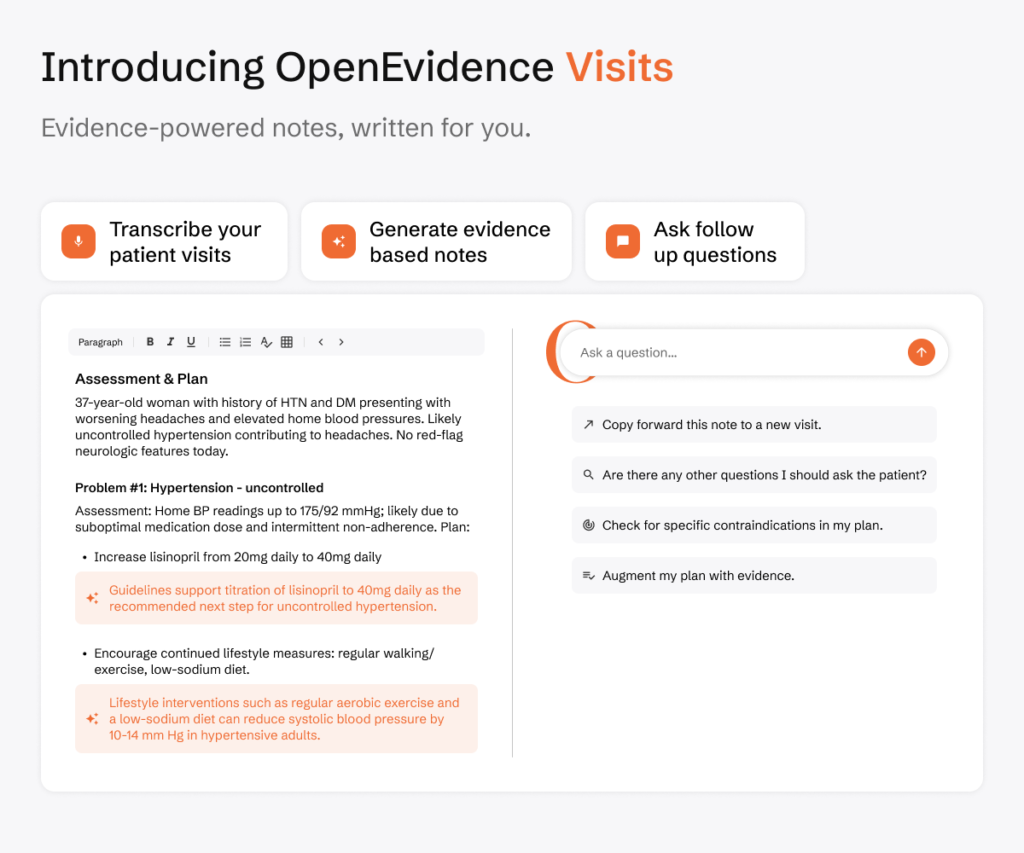
Founded in 2022 by Daniel Nadler and Zachary Ziegler, OpenEvidence delivers an AI-powered medical search and decision-support platform for verified healthcare professionals. It aggregates and synthesizes peer-reviewed research — including from The New England Journal of Medicine and JAMA — to help doctors and nurses ask natural-language clinical questions and receive timely, evidence-grounded summaries.
Its mission? To tame the explosion of medical knowledge — which is doubling every few years — and give clinicians a usable interface for decision-making at the point of care.
Metrics & Adoption
OpenEvidence reports that over 40 % of U.S. physicians are now active users of its platform, logging in daily.
The system handled more than 8.5 million clinical consultations per month in recent months — up from about 358,000 a year earlier.
The platform is free for verified U.S. clinicians; revenue is driven through advertising — much like the model for consumer search.
Why This Round Matters
The jump to a $6 billion valuation signals that investors believe specialty-AI platforms (focused on narrow domains like medicine) may be the next frontier — not general-purpose models alone. The new funds will allow OpenEvidence to deepen its content partnerships, expand advanced reasoning features, and scale globally.
According to the company, it will invest further in “AI agents” tailored for physician research workflows, as well as international rollout.
Strategic Backers
The round was led by elite venture firms including Google Ventures (GV) and Kleiner Perkins, with participation from Sequoia Capital, Coatue Management, Thrive Capital, Bond and Craft Ventures.
Implications for Healthcare
- Bridging the knowledge gap: With research output growing exponentially, clinicians are under pressure to stay current. OpenEvidence attempts to compress that lag time.
- Evidence-based care at scale: By using curated sources and advanced reasoning models, the startup supports decision-making with citations and nuanced analysis.
- Monetisation and access model: Free to verified doctors, monetised via ads, the model mimics consumer search services but in a regulated clinical domain.
- Global expansion ahead: While U.S. adoption is high, the next stage will likely involve international regulatory compliance, multilingual support and diverse health-system integrations.
Challenges & Considerations
- Regulation & liability: As AI moves deeper into clinical decisions, regulatory oversight around safety, evidence standards, and accountability will intensify.
- Data bias & model accuracy: The platform achieves strong grades on exams (e.g., 100% on the USMLE according to some internal metrics) but real-world outcomes remain to be rigorously validated.
- Competitive landscape: As the descriptor “ChatGPT for doctors” becomes standard, competitors and incumbents will intensify their efforts in this domain.