

In a surprising move, the Grammarly Superhuman rebrand is shaking up the AI productivity landscape. Grammarly, long known for its writing enhancement tools, has officially rebranded itself as “Superhuman” following its acquisition of the email client Superhuman in July.
While the Grammarly Superhuman rebrand gives the company a fresh identity, its flagship product will still be called “Grammarly.” However, the company hinted at future changes — potentially rebranding other acquisitions like Coda, a productivity platform it bought last year, under the unified Superhuman brand umbrella.
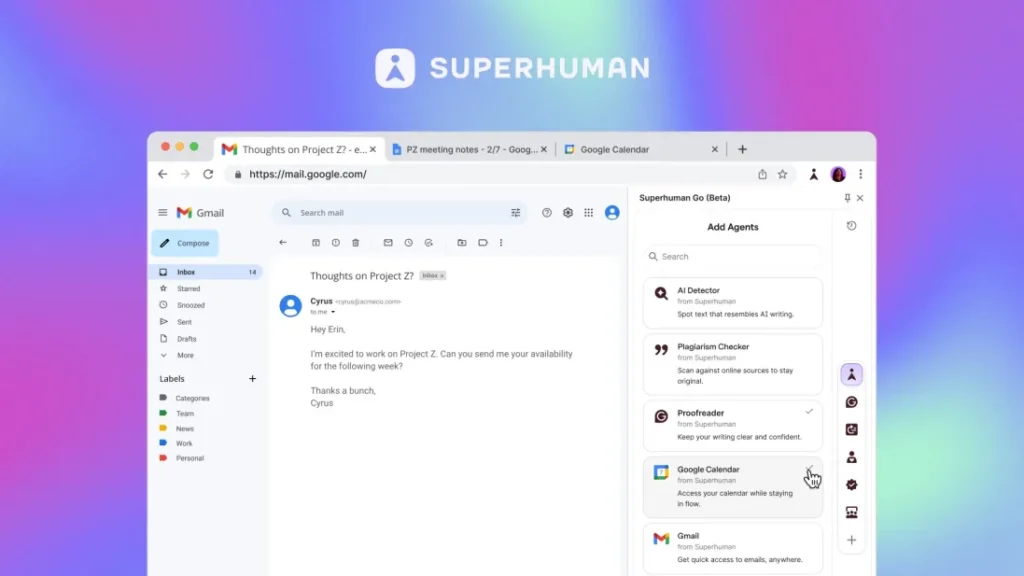
As part of the Grammarly Superhuman rebrand, the company unveiled Superhuman Go, a powerful AI assistant integrated directly into Grammarly’s existing browser extension. This assistant is designed to go beyond grammar checking — providing intelligent writing suggestions, contextual feedback on emails, and even task automation across platforms.
With Superhuman Go, users can connect to popular tools like Gmail, Google Drive, Jira, and Google Calendar. The assistant uses these integrations to perform context-aware actions — such as fetching meeting availability, logging tickets, or summarizing long email threads.
Superhuman also plans to expand its AI ecosystem by allowing the assistant to pull data from CRMs and internal systems, creating even more personalized recommendations.
All users can activate Superhuman Go in the Grammarly extension via a toggle, enabling them to explore specialized “agents” in the company’s agent store — including a plagiarism checker and proofreader, both released earlier this year.
The company has introduced tiered subscription options as part of the Grammarly Superhuman rebrand. The Pro plan, at $12 per month (billed annually), offers multilingual grammar and tone support, while the Business plan, priced at $33 per month, includes access to Superhuman Mail and advanced productivity features.
Looking ahead, Superhuman aims to integrate more AI-driven functionality into its Coda suite and email client — automatically generating content, pulling data from external and internal sources, and drafting emails or documents with precision.
This Grammarly Superhuman rebrand underscores the company’s ambitions to evolve beyond writing assistance. By merging its AI writing expertise with Superhuman’s sleek productivity tools, it’s positioning itself as a direct competitor to Notion, ClickUp, and Google Workspace — platforms that have all recently leaned heavily into AI innovation.
In an era where intelligent assistants are becoming indispensable, the Grammarly Superhuman rebrand marks a bold new chapter for one of the world’s most popular AI writing companies.
Stay ahead of the curve—follow us for the latest AI news, breakthroughs, and insights that matter.