

The Roblox 4D creation feature is officially available in open beta, marking a major step forward in how games and virtual worlds are built on the platform. The new tool allows creators to generate not just static 3D assets, but interactive, functional objects that can move, respond, and behave inside games.
The rollout follows Roblox’s earlier success with Cube 3D, its open-source AI model for generating 3D objects. Since launching last year, Cube 3D has helped creators generate more than 1.8 million 3D items, ranging from furniture and accessories to vehicles. With the 4D system, Roblox is adding a crucial missing layer: interactivity.
What Makes the Roblox 4D Creation Feature Different
Traditional 3D models on Roblox were static by design. Even complex items like vehicles existed as single, solid objects with no native movement. The Roblox 4D creation feature changes that by breaking objects into parts and assigning behaviors to each component.
In practical terms, this means AI-generated objects can now:
- Move naturally within the game world
- React to players and physics
- Function as usable items rather than visual props
Roblox describes this as moving from “what something looks like” to “what something can do.”
Two Object Schemas Available at Launch
At launch, creators can experiment with two predefined templates, known as schemas, that define how objects are structured and how they behave.
The first schema, Car-5, generates vehicles made up of five distinct components: a body and four wheels. Under the old system, cars were rigid models. With the new approach, wheels spin independently, allowing cars to actually drive and behave like vehicles rather than decorative assets.
The second schema, Body-1, is designed for single-piece objects such as sculptures, boxes, or simple props. While less complex, it provides a foundation for experimenting with AI-generated forms that still respond to game logic.
Roblox says more schemas are coming, and creators will eventually be able to design their own, unlocking far more creative freedom.
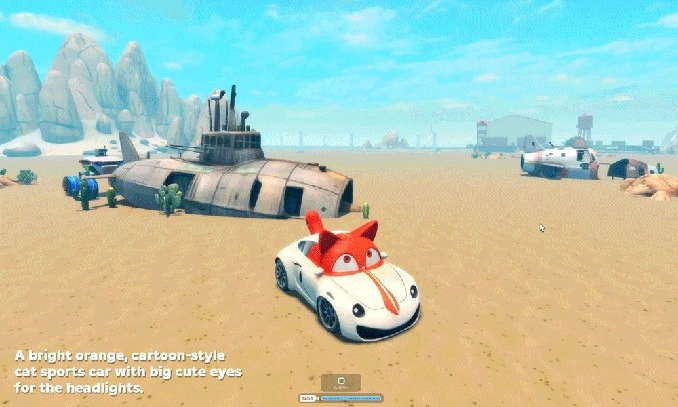
First Look: ‘Wish Master’ Showcases 4D Generation
The first playable experience built with the Roblox 4D creation feature is a game called Wish Master. In it, players can generate and interact with objects in real time—driving cars, flying planes, and even summoning dragons.
The experience acts as both a showcase and a testing ground, giving developers a glimpse of how AI-generated interactivity could reshape gameplay design across genres.
What’s Coming Next for AI Creation on Roblox
Roblox isn’t stopping at 4D object generation. The company says it’s working on technology that will allow creators to upload a reference image and generate a detailed 3D model that matches the image’s style and structure.
Longer term, Roblox is investing in a concept it calls “real-time dreaming.” Roblox CEO David Baszucki recently explained that this initiative would allow creators to build entire worlds using keyboard navigation and live text prompts, essentially generating environments on the fly.
Together, these tools point toward a future where building games becomes faster, more intuitive, and less dependent on traditional 3D modeling skills.
Safety and Platform Context
The open beta launch arrives shortly after Roblox implemented mandatory facial verification for users accessing chat features. The move followed lawsuits and investigations related to child safety, underscoring the company’s effort to balance rapid innovation with platform responsibility.
While unrelated to the Roblox 4D creation feature itself, the timing highlights how Roblox is evolving both its creative tooling and its safety infrastructure in parallel.
Why This Matters for Creators
For Roblox’s massive creator community, the shift from static assets to interactive AI-generated objects could significantly lower the barrier to building rich, playable experiences. Instead of manually scripting behavior, developers can increasingly rely on AI-driven systems to handle structure and interaction.
If widely adopted, the Roblox 4D creation feature could redefine how games are prototyped, built, and iterated—especially by smaller teams and solo creators.

Don’t miss out on our latest news—follow us for the latest AI news, breakthroughs, and insights that matter.