

The NASA AI Mars rover test has officially marked a turning point in space exploration. For the first time, artificial intelligence plotted a driving route for NASA’s Perseverance rover — and the mission went smoothly.
Driving on Earth takes seconds to plan. Driving 140 million miles away on Mars requires complex terrain analysis, hazard avoidance, and careful waypoint mapping. Traditionally, NASA’s Jet Propulsion Laboratory (JPL) engineers manually design each rover movement. But in December, that process changed.
And the results are significant.
How the NASA AI Mars Rover Test Was Conducted
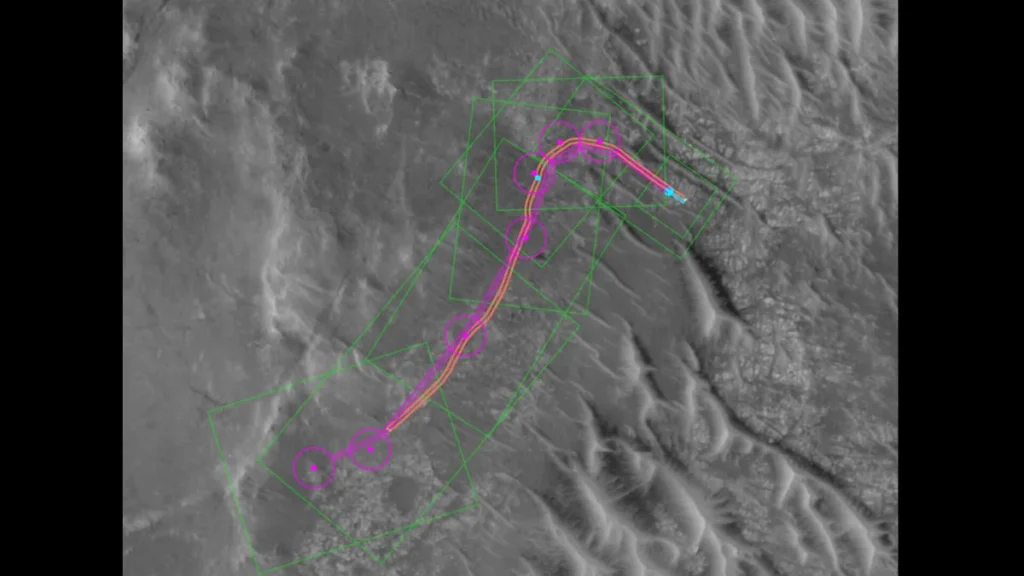
The NASA AI Mars rover test took place on December 8 and December 10. Instead of relying solely on human operators, NASA used Anthropic’s Claude AI models to generate driving waypoints for Perseverance.
Here’s how it worked:
- AI was given satellite imagery and orbital data from NASA’s Mars Reconnaissance Orbiter.
- It analyzed terrain, obstacles, and slope safety.
- The system generated safe navigation waypoints.
- JPL engineers reviewed and slightly refined the route.
- The updated path was transmitted to Perseverance.
- The rover completed the drive autonomously.
Across two demonstrations, Perseverance traveled just under 1,500 feet with no reported issues — validating the success of the NASA AI Mars rover test.
Why the NASA AI Mars Rover Test Is Important
Mars exploration moves slowly and deliberately. Waypoints are typically spaced about 330 feet apart, meaning the rover advances roughly one football field at a time.
To understand the scale:
- Perseverance’s climb out of Jezero Crater in 2024 took 3.5 months.
- The rover climbed 1,640 vertical feet during that journey.
- As of December 2025, Perseverance has driven just 25 miles in nearly four years.
The NASA AI Mars rover test suggests that AI-assisted navigation could help increase operational efficiency while maintaining safety.
NASA Administrator Jared Isaacman noted that autonomous technologies allow missions to:
- Operate more efficiently
- Handle challenging terrain
- Increase science return
- Reduce operator workload
In short, AI becomes a force multiplier — not a replacement.
AI’s Expanding Role on Mars
The impact of the NASA AI Mars rover test goes beyond navigation.
JPL roboticist Vandi Verma indicated that AI systems could eventually:
- Flag scientifically interesting geological features
- Reduce manual review of large image datasets
- Accelerate analysis timelines
- Support longer-range autonomous drives
Given the massive volumes of imagery and terrain data Mars rovers collect, AI could significantly streamline mission workflows.
A Carefully Controlled Demonstration
Importantly, NASA did not hand over full control to AI.
Every AI-generated route was reviewed by JPL engineers before transmission. The NASA AI Mars rover test was designed as a demonstration — showing how advanced autonomy can complement human oversight.
While AI often faces criticism for lower-quality online content generation, this test demonstrates its strength in structured, data-heavy scientific applications.
What the NASA AI Mars Rover Test Means for the Future
As missions venture farther into deep space, communication delays grow longer. Real-time human control becomes less practical. Autonomous systems become essential.
The NASA AI Mars rover test may have covered just 1,500 feet — but strategically, it represents a major step forward.
AI-driven exploration could redefine how humanity navigates Mars and beyond.
And for now, the experiment has proven one thing: AI can drive on Mars — safely.

Don’t miss out on our latest news—follow us for the latest AI news, breakthroughs, and insights that matter.