

The Gemini 3.1 Pro launch marks Google’s latest step in advancing artificial intelligence capabilities, introducing a new model designed for tasks where simple answers are not enough. The upgraded AI system focuses on deeper reasoning, improved intelligence, and enhanced performance for complex problem-solving scenarios.
The announcement follows Google’s earlier rollout of Gemini 3 Pro in November and Gemini 3 Flash shortly afterward, positioning Gemini 3.1 Pro as a significant upgrade in the company’s evolving AI model lineup.
Gemini 3.1 Pro Brings Improved Reasoning Capabilities
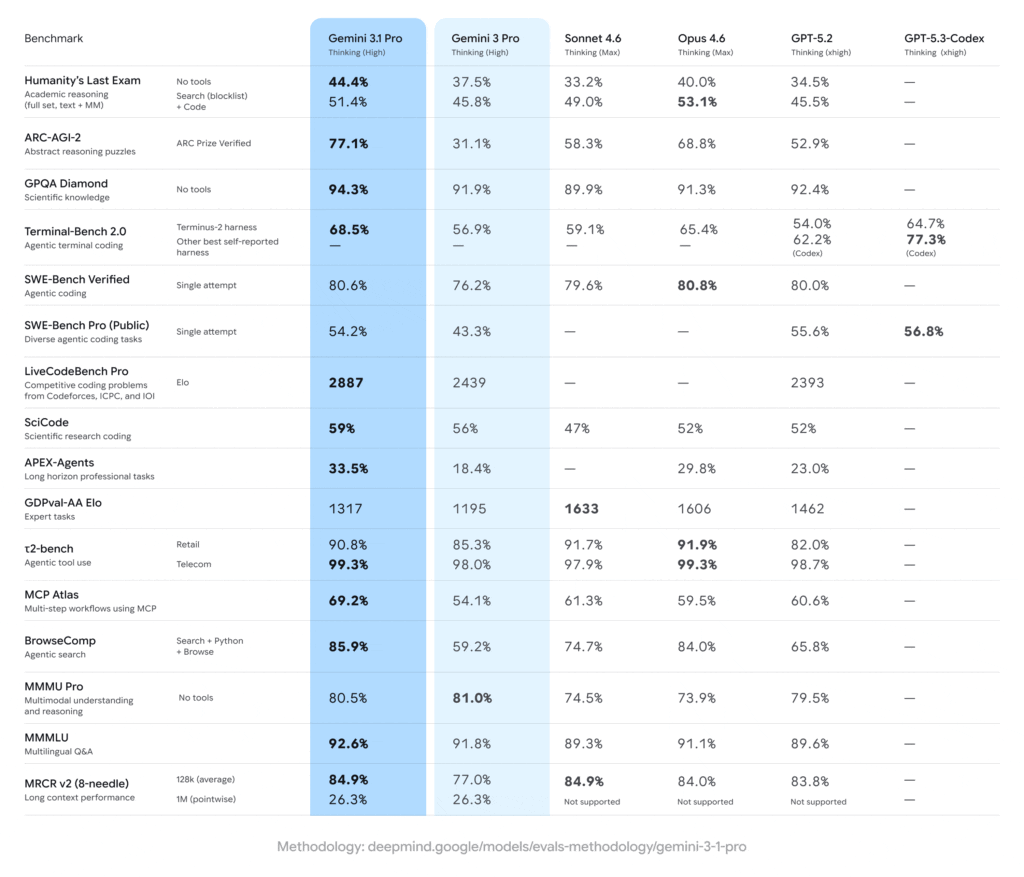
With the Gemini 3.1 Pro launch, Google says the model represents a major leap forward in core reasoning performance. The new system incorporates upgraded intelligence first introduced with Gemini 3 Deep Think, now available to a broader set of users.
According to Google, Gemini 3.1 Pro achieved an ARC-AGI-2 score of 77.1%, more than doubling the reasoning performance of Gemini 3 Pro. This improvement enables the model to handle advanced tasks such as generating visual explanations of complex topics, synthesizing large datasets, and supporting creative projects.
The enhanced reasoning capabilities make Gemini 3.1 Pro particularly suited for scenarios requiring deeper analysis and structured problem-solving.
Availability Across Google’s AI Ecosystem
The Gemini 3.1 Pro launch also expands access across Google’s AI ecosystem. The model is rolling out to the Gemini app and NotebookLM for Google AI Pro and Ultra subscribers.
Developers can access Gemini 3.1 Pro through multiple platforms, including the Gemini API via Google AI Studio, Antigravity, Vertex AI, Gemini Enterprise, Gemini CLI, and Android Studio. This broad integration highlights Google’s strategy to embed advanced AI capabilities across both consumer and enterprise applications.
Preview Phase and Future AI Developments
Google confirmed that the Gemini 3.1 Pro launch is currently in preview mode. The company aims to validate improvements and continue refining features, particularly in areas such as agentic workflows, before making the model generally available.
The preview phase will help Google gather feedback and further advance the model’s capabilities, reinforcing its focus on building AI systems capable of handling increasingly sophisticated tasks.
The release signals Google’s ongoing push to strengthen its position in the competitive AI landscape by delivering more powerful reasoning models for users and developers.

Don’t miss out on our latest news—follow us for the latest AI news, breakthroughs, and insights that matter.