

Google is facing renewed scrutiny after an automated news alert included a racial slur in a push notification, prompting what is now widely being described as a Google offensive push notification apology.
The incident unfolded over the weekend following coverage of a controversy at the BAFTA Film Awards. According to Deadline reports, Google sent out a notification linking to an article titled “How the Tourette’s Fallout Unfolded at the BAFTA Film Award.” The problem was not the headline itself, but the appended notification text, which prompted users to “see more on” followed by an explicit racial slur.
The screenshot quickly went viral after being shared by influencer Danny Price, who publicly criticized the message. The backlash was immediate and intense, particularly given the sensitivity of the language and timing.
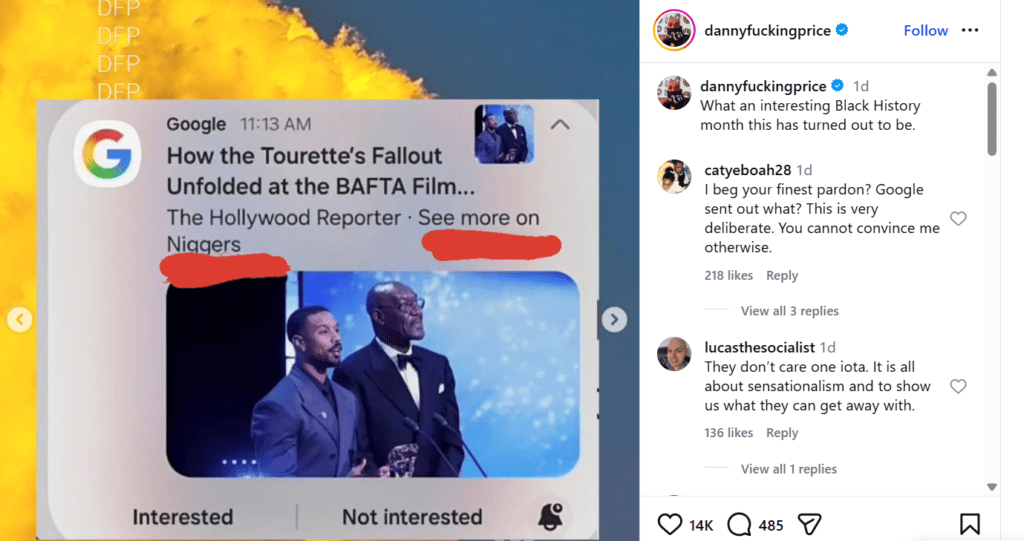
Google Offensive Push Notification Apology Issued
After the screenshot gained widespread attention, Google issued a public statement acknowledging the error. The Google offensive push notification apology included confirmation that the alert had been removed and that internal systems were being reviewed to prevent recurrence.
A company spokesperson stated that the mistake was the result of a system error and emphasized that no artificial intelligence model directly generated the slur. Instead, Google clarified that its system identified euphemistic references to offensive language on certain webpages and mistakenly substituted the explicit term into the notification text.
The company further noted that its safety filters failed to trigger as intended.
AI Automated News Notification Errors Under Scrutiny
Despite Google’s insistence that AI was not involved in this specific case, the controversy has reignited debate over AI automated news notification errors and the risks of relying on automated systems to distribute sensitive content.
Automation in news distribution has expanded rapidly across major platforms. According to multiple industry analyses, automated summarization and push notification systems are designed to boost engagement and reduce editorial workload. However, when these systems misinterpret context or fail to apply safeguards, the consequences can be severe.
The episode highlights a broader industry challenge: automated systems can amplify errors at scale, especially when dealing with nuanced or sensitive language.
Google Discover AI Content Moderation Failure Raises Concerns
The situation also revived discussions about Google Discover AI content moderation failure. Just last month, reporting by The Verge revealed instances where Google Discover surfaced AI-generated headlines that altered the original framing of stories.
Similar automation missteps have been documented across the tech industry. In 2024, Apple’s AI-powered news summarization feature inaccurately reported that an individual had died by suicide, prompting a formal complaint from the BBC, as widely reported. Meanwhile, The Washington Post faced criticism after deploying an AI-generated podcast feature that misattributed quotes shortly after launch.
While Google maintains that this latest incident did not directly involve AI generation, critics argue that AI automated news notification errors and moderation gaps remain systemic risks as platforms scale automated content systems.
Automation and Accountability in Digital News
The Google offensive push notification apology underscores the delicate balance between efficiency and responsibility. Automated news distribution can enhance speed and personalization, but it also reduces human editorial oversight at critical junctures.
As technology companies integrate more automated systems into content delivery pipelines, scrutiny around moderation frameworks is likely to intensify. Research from institutions such as the Reuters Institute for the Study of Journalism has previously highlighted public trust concerns tied to automated news production and algorithmic curation.
The incident serves as another reminder that in sensitive news contexts, precision is not optional—it is essential.

Don’t miss out on our latest news—follow us for the latest AI news, breakthroughs, and insights that matter.