

Could your favorite song secretly be written by artificial intelligence? The debate around AI vs human music composers is heating up as new AI tools like AIVA, Mubert, and Suno create full-length songs that sound almost indistinguishable from human work.
The result? A fascinating question: Can listeners really tell the difference? Researchers and streaming platforms are already testing how we perceive AI-generated music, while audiences are split between admiration and unease.
In this post, you’ll explore both sides — plus take an interactive quiz featuring real examples to see if your ears can spot AI-crafted melodies. Ready to put your musical instincts to the test?
The Rise of AI in Music Composition
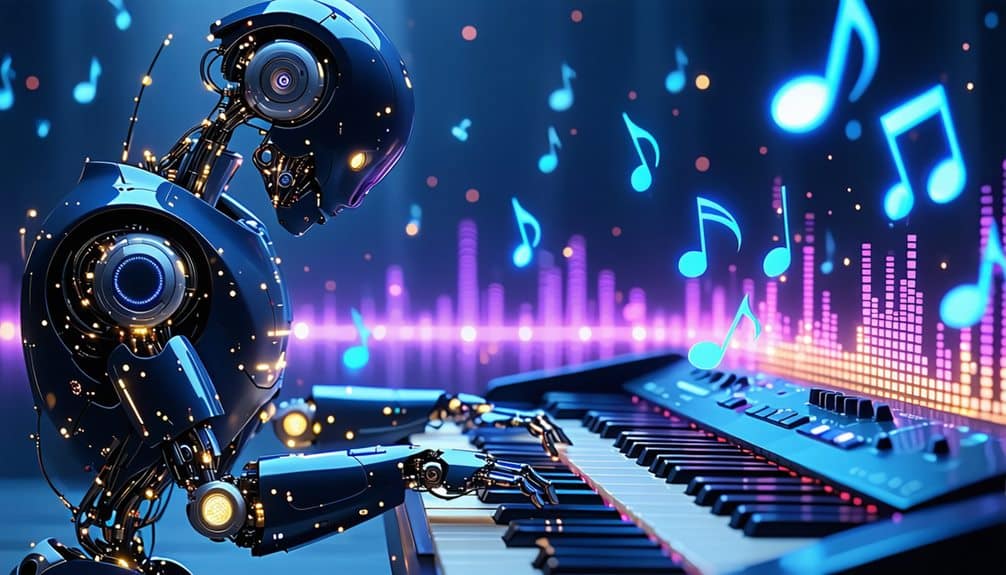
Artificial intelligence has moved from simple note generators to full-fledged music composers. Tools like AIVA, Mubert, and Suno AI can now analyze thousands of human-made tracks and generate melodies, harmonies, and rhythms in minutes.
AI’s strength lies in speed and precision—it can instantly create custom soundtracks for films, games, or social media content. But as AI music becomes more convincing, many wonder: are we witnessing innovation or imitation?
How Human Composers Create Music Differently
Unlike machines, human composers create music from emotion, memory, and lived experience. Every melody carries intention — joy, heartbreak, nostalgia — something algorithms can only imitate. When Hans Zimmer scores a film or Billie Eilish crafts a haunting vocal line, they’re expressing personal stories, not patterns in data.
Human creativity thrives on imperfection. A slight tempo change, a trembling note, or an unexpected chord can evoke deep emotion precisely because it’s not mathematically perfect. These “flaws” give human-made music warmth and authenticity — qualities that AI often struggles to replicate.
Moreover, human composers draw from cultural and emotional contexts that machines can’t fully grasp. Whether it’s Indian classical ragas, jazz improvisation, or modern EDM, composers blend tradition and innovation through feeling and experience.
While AI learns from existing data, humans invent new sounds and push boundaries. This emotional depth is what continues to separate human vs AI composed music examples — at least for now.
Direct Comparison — AI vs Human Music Composers
When we place AI vs human music composers side by side, the contrast reveals both strengths and weaknesses on each side. AI impresses with precision, consistency, and adaptability, while humans bring emotion, intent, and cultural nuance.
Let’s break it down:
| Aspect | AI Composers | Human Composers |
|---|---|---|
| Speed & Efficiency | Can produce hundreds of tracks in minutes | Time-intensive, relies on inspiration and iteration |
| Creativity | Draws from existing data; struggles to innovate | Creates from emotion, experience, and experimentation |
| Emotional Depth | Mimics patterns of emotion but lacks true feeling | Infuses music with authentic emotional storytelling |
| Variation | May repeat motifs or patterns | Naturally introduces imperfections and surprises |
| Adaptability | Can instantly match genre or style | Adapts creatively but within personal or cultural limits |
AI shines in tasks like background scoring or mood-based playlists, where consistency matters more than individuality. Human composers, however, excel at crafting memorable melodies and emotionally resonant soundtracks that stay with us.
Ultimately, AI provides a toolkit — but humans provide the soul.
The Ultimate Quiz — Can You Tell Which Track Was Composed by AI?
Now it’s time to test your instincts. You’ve learned how machines and humans approach music differently — but can you actually tell them apart? Welcome to the artificial intelligence music composer test, where your ears get to play detective.
Below are five short clips — a mix of AI-generated and human-composed pieces. Listen carefully and note which ones you think were made by AI. Focus on emotional flow, structure, and variation.
The Challenge: Listen & Guess
- Clip A: Melodic, cinematic score — rich strings and piano (AI or Human?)
- Clip B: Upbeat electronic loop with repeating chords (AI or Human?)
- Clip C: Soulful acoustic guitar with subtle tempo shifts (AI or Human?)
- Clip D: Energetic EDM track with complex drops (AI or Human?)
- Clip E: Dreamy ambient background with perfect transitions (AI or Human?)
Take a moment to write down your guesses before checking below!
The Reveal: Answers & Analysis
- Clip A — AI (AIVA): Balanced and clean, but slightly mechanical dynamics.
- Clip B — Human: Notice the evolving layers and rhythmic creativity.
- Clip C — Human: The micro-tempo changes and breathy phrasing give it away.
- Clip D — AI (Suno AI): Great production value, but emotion feels surface-level.
- Clip E — AI (Mubert): Smooth transitions, yet lacks the subtle unpredictability humans bring.
If you guessed at least three correctly, your musical intuition is sharper than most! Studies show that even trained listeners often struggle to distinguish AI music from human compositions — especially as models become more sophisticated.
So, what exactly should you listen for when identifying AI music?
How to Tell AI-Generated vs Human-Composed Music
Spotting the difference between AI vs human music composers is getting harder — but a few subtle clues can still help. Here’s how to sharpen your ear during the artificial intelligence music composer test.
Key Differences to Listen For
- Repetition:
AI loves loops. If a song feels too predictable or endlessly repeating, it’s likely machine-made. - Emotion vs Precision:
AI delivers clean perfection, but lacks “feel.” Humans express emotion through tiny imperfections — rushed notes, breath, silence. - Story Progression:
Human compositions evolve — they build tension and resolve it. AI often keeps the same mood from start to finish. - Instrument Texture:
Digital instruments can sound overly smooth or artificial, missing the warmth of live performance. - Lyrics (if any):
AI lyrics can rhyme and flow but rarely mean something deep. Humans use words to convey intent and emotion.
Quick Tip: If a track sounds flawless but emotionally flat — it’s probably AI.
The Science Behind Why We Struggle to Tell the Difference
Even experts struggle to separate AI vs human music composers — and science explains why. Our brains react emotionally to patterns and cues, not necessarily their origin.
Why It’s Hard to Tell
- Familiarity Bias:
AI reuses musical patterns we already know, so our brains instinctively accept them as “human.” - Expectation Effect:
People rate the same song differently based on what they’re told — “AI-made” vs “human-made.” - Realistic Sound Design:
Modern AI tools replicate instrument tone, phrasing, and dynamics almost perfectly. - Emotional Shortcuts:
AI mimics emotional triggers — like minor keys for sadness or rising crescendos for tension — fooling the brain.
Bottom line: Our ears feel emotion before our logic kicks in. That’s why AI can sound human — even when it isn’t.

The Future — Collaboration, Not Competition
The future of AI vs human music composers isn’t a rivalry — it’s teamwork. AI isn’t replacing musicians; it’s reshaping how music is made and who gets to make it.
Key Trends Shaping the Future
- AI as a Creative Partner:
Tools like AIVA and Suno AI help composers brainstorm melodies or harmonies, acting as co-creators, not competitors. - Speed + Emotion:
AI handles structure and repetition; humans add emotion, imperfection, and intent. Together, they create music faster and deeper. - Music for Everyone:
Platforms such as Mubert make composing accessible — no formal training required, just imagination. - A New Kind of Art:
The future will blend machine precision with human feeling — a true fusion of creativity.
Bottom line: AI provides the tools; humans provide the soul. The harmony between both defines the next era of music.
Conclusion — Who Wins the Music Showdown?
So, who truly wins the battle of AI vs human music composers? The honest answer: neither side loses. Each brings unique strengths to the table — AI with its precision and limitless productivity, humans with emotion, imperfection, and story.
Key Takeaways
- AI enhances creativity, not replaces it.
- Humans infuse meaning, emotion, and story.
- The future of music lies in collaboration, not competition.
Challenge yourself: Take the quiz, listen to the clips, and see if your ear can spot the difference between human and machine-made music.


