

OpenAI has unveiled GPT-5-Codex, an advanced upgrade to its AI coding agent Codex, aimed at revolutionizing how developers use AI in software creation.
The company announced Monday that GPT-5-Codex introduces dynamic “thinking time,” allowing the model to spend anywhere from a few seconds to seven hours on a coding task. This makes it significantly more accurate on coding benchmarks compared to previous versions.
The new model is now available across Codex products — including terminal, IDE, GitHub, and ChatGPT — for ChatGPT Plus, Pro, Business, Edu, and Enterprise users. OpenAI plans to extend access to API customers soon.
Competing in a Growing AI Coding Market
The upgrade comes as OpenAI faces mounting competition from tools like Claude Code, Anysphere’s Cursor, and Microsoft’s GitHub Copilot. Demand for AI coding tools has surged, with Cursor surpassing $500 million in ARR in 2025, while Windsurf, another coding editor, saw a split acquisition attempt involving Google and Cognition.
Benchmark Performance and Code Reviews
OpenAI says GPT-5-Codex outperforms GPT-5 on SWE-bench Verified, a benchmark for agentic coding tasks, and on large-scale code refactoring tests.
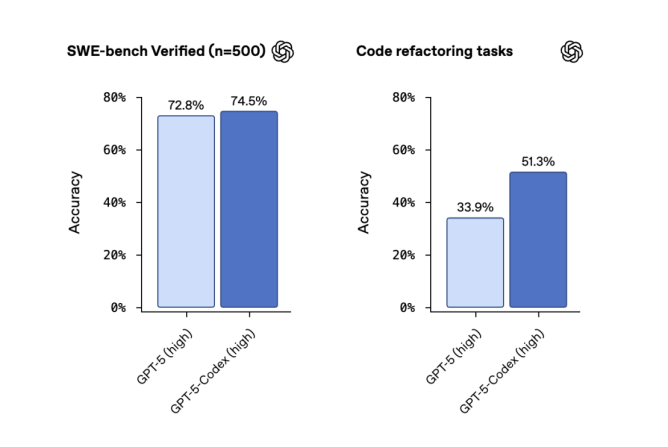
The company also trained the model for code reviews, with senior software engineers finding GPT-5-Codex made fewer incorrect comments and delivered more “high-impact” feedback.
Dynamic Thinking for Better Accuracy
Alexander Embiricos, Codex product lead at OpenAI, explained that GPT-5-Codex’s strength lies in its ability to dynamically decide how long to work on a problem. Unlike traditional routing systems that allocate resources upfront, GPT-5-Codex can extend its processing time mid-task if needed, with some tasks taking up to seven hours.
“This flexibility leads to more accurate results, especially on complex coding problems,” Embiricos said.
Looking Ahead
With GPT-5-Codex, OpenAI aims to set a new standard in AI-assisted coding, offering developers improved speed, accuracy, and reliability as they integrate AI into software workflows.