

Zelda Williams, the daughter of legendary comedian Robin Williams, has issued a heartfelt plea to fans — stop sending her AI deepfakes of Robin Williams.
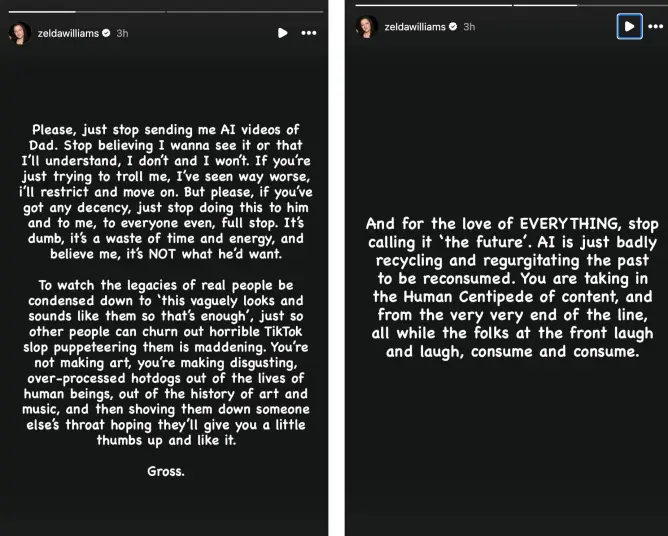
In an emotional Instagram Story on Monday, Zelda urged people to stop sharing or creating synthetic videos of her late father.
“Please, just stop sending me AI videos of Dad. Stop believing I wanna see it or that I’ll understand. I don’t and I won’t,” she wrote.
“If you’ve got any decency, just stop doing this to him and to me, to everyone even, full stop.”
Her statement follows the recent release of OpenAI’s Sora 2, a powerful AI video-generation model and accompanying social app that allows users to create lifelike deepfakes of themselves — and, controversially, of the deceased.
AI Deepfakes Stir Ethical Outrage
Sora 2, which remains invite-only, enables users to produce stunningly realistic videos of historical and fictional figures. While the platform prevents users from generating videos of living individuals without consent, there appear to be no restrictions for deceased people.
That loophole has led to a flood of AI-generated clips featuring historical icons and late celebrities, including Martin Luther King Jr., Franklin D. Roosevelt, Bob Ross, John Lennon, Alex Trebek, and Robin Williams.
The issue, as Zelda Williams points out, goes beyond legality — it’s about dignity and legacy.
“To watch the legacies of real people be condensed down to ‘this vaguely looks and sounds like them so that’s enough,’ just so other people can churn out horrible TikTok slop puppeteering them is maddening,” she said.
Legal Gray Areas Around AI and the Deceased
According to the Student Press Law Center, it’s not illegal to “libel the dead.” However, that doesn’t make using AI deepfakes of Robin Williams or other deceased figures ethically acceptable.
Testing by TechCrunch revealed inconsistencies in Sora’s generation filters — for example, it refuses to create videos of Michael Jackson or Jimmy Carter, but allows those of Robin Williams.
Unlike living users, the deceased can’t give consent or define how their likeness should appear in AI-generated content. This has reignited debates over digital rights, posthumous consent, and AI governance.
OpenAI Faces Mounting Backlash
Critics accuse OpenAI of taking a “fast-and-loose” approach to moderation. Upon launch, Sora was quickly flooded with copyrighted and controversial content, including fictional characters like Pikachu and Peter Griffin.
The Motion Picture Association (MPA) has already demanded stricter controls, emphasizing that copyright law “safeguards the rights of creators.” OpenAI CEO Sam Altman initially claimed studios would have to opt out if they didn’t want their IP used, but he has since pledged to reverse that policy.
The Bigger Picture: AI Ethics and Digital Consent
As AI tools become increasingly lifelike, the question remains: should technology allow us to recreate those who can no longer speak for themselves?
While OpenAI insists Sora 2 promotes creativity, critics warn it sets a dangerous precedent — where AI deepfakes of Robin Williams and others blur the line between homage and exploitation.
Zelda Williams’ message is clear: just because you can doesn’t mean you should.