

Artificial intelligence is no longer “the future.” It’s infrastructure.
From diagnosing diseases to writing code and generating cinematic videos, AI systems are reshaping how industries operate and how individuals work every single day. Yet despite the headlines, most people only know a fraction of the facts about AI that truly define its impact.
In 2026, artificial intelligence is growing faster than mobile apps did in the 2010s. According to industry forecasts from organizations like PwC and McKinsey & Company, AI could contribute trillions of dollars to the global economy this decade. Meanwhile, adoption rates across enterprises have surged dramatically in just a few years.
But beyond market valuations and investment numbers, there are deeper, more surprising truths.
Some are impressive.
Some are uncomfortable.
And some are genuinely mind-blowing AI facts that challenge how we think about intelligence itself.
In this article, you’ll discover:
- Verified artificial intelligence statistics shaping 2026
- Fascinating facts about artificial intelligence that rarely make headlines
- Emerging trends backed by credible research
- And 30 carefully researched facts about AI that reveal where we’re really headed
Let’s begin with a quick snapshot of where AI stands right now.
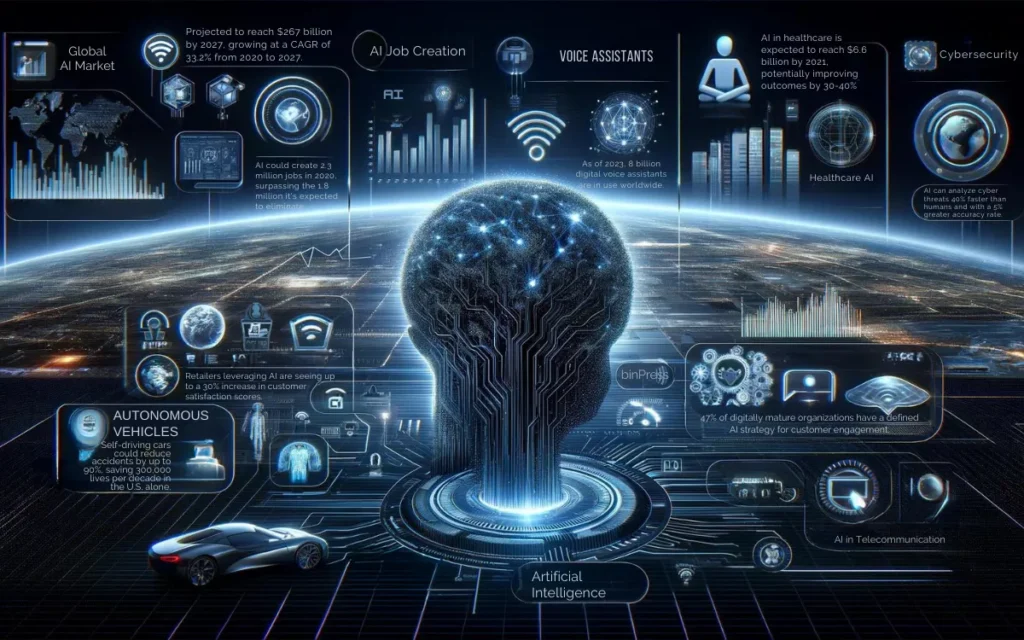
AI in 2026 at a Glance (Quick Data Snapshot)
Before diving into detailed insights, here’s a high-level overview supported by major industry analyses:
- The global AI market is projected to exceed $500+ billion within the next few years (source: Statista reports and industry forecasts).
- Over 50% of organizations report using AI in at least one business function (based on research from McKinsey & Company).
- Generative AI tools gained over 100 million users faster than any consumer software in history.
- AI is now integrated into healthcare diagnostics, autonomous systems, cybersecurity, and financial risk modeling.
- Investment in AI startups continues to dominate global venture capital funding trends.
These artificial intelligence statistics confirm one thing clearly:
AI is no longer experimental. It is foundational.
Now let’s move from macro-level numbers to the insights that truly surprise people.
Comparison: AI Then vs AI Now
To appreciate today’s facts about AI, it helps to understand how dramatically the landscape has shifted.
AI in 2016:
- Limited natural language understanding
- Narrow task-based systems
- Minimal public interaction
- Slow enterprise adoption
AI in 2026:
- Multimodal systems (text, image, video, audio combined)
- AI copilots integrated into productivity tools
- Autonomous AI agents executing complex workflows
- Consumer-grade generative models
According to research updates from Stanford University’s AI Index Report, model training datasets and compute usage have grown exponentially over the past decade. What once required research labs now runs on consumer hardware and cloud APIs.
This exponential growth sets the stage for some truly interesting facts about artificial intelligence.
30 Mind-Blowing AI Facts That Sound Unreal
AI is not just advancing in one industry. It is expanding horizontally across healthcare, finance, software, research, media, and governance simultaneously. Let’s begin with the category that captures attention immediately.
1. AI Can Analyze Medical Images More Accurately Than Some Specialists
Deep learning models trained on radiology datasets have achieved diagnostic accuracy comparable to human experts in certain domains. Research published in peer-reviewed journals and tracked by institutions like Stanford University highlights AI’s ability to detect patterns invisible to the human eye.
This is one of the most impactful facts about AI in healthcare.
2. Generative AI Reached 100 Million Users in Record Time
Consumer AI platforms saw adoption faster than major social media platforms did in their early days. This explosive growth reshaped how software products scale globally.
That growth curve remains one of the most cited artificial intelligence statistics in tech circles.
3. AI Models Train on Trillions of Words
Large language models process enormous volumes of public data to learn linguistic patterns. The scale is almost incomprehensible — trillions of tokens processed using high-performance GPUs in massive data centers.
This is one of those mind-blowing AI facts that illustrates just how data-intensive modern systems are.
4. AI Is Writing Code Used in Production Systems
Developers increasingly rely on AI copilots to generate and debug code. According to enterprise surveys, AI-assisted programming significantly reduces development time.
Software engineering workflows are being redefined.
5. AI Is Predicting Protein Structures
Breakthroughs in protein-folding prediction have accelerated drug discovery and biological research. This advancement represents one of the most scientifically important interesting facts about artificial intelligence in recent years.
6. AI Systems Can Generate Ultra-Realistic Video
Multimodal models now generate photorealistic video content with synchronized audio and natural motion. This advancement is transforming media production and marketing.
7. AI Is Becoming Energy Intensive
Training frontier AI models consumes substantial computational power. Energy usage and sustainability concerns are increasingly part of AI governance discussions.
This is one of the more sobering facts about AI that often gets overlooked.
8. AI Bias Is a Measurable Problem
Studies show that AI systems can inherit biases present in training data. Ethical AI frameworks are now central to enterprise deployment strategies.
9. AI Is Being Used in Climate Modeling
Machine learning accelerates climate simulations and environmental risk assessments, enabling more accurate forecasting.
10. AI Investment Is Outpacing Most Emerging Technologies
Venture capital and enterprise spending on AI now exceed many previous tech cycles combined. This artificial intelligence statistic underscores AI’s dominance in innovation funding.
11. AI Could Contribute $15+ Trillion to the Global Economy
According to projections from PwC, AI may add up to $15.7 trillion to the global economy by 2030. That would make it one of the largest commercial opportunities in modern history.
This remains one of the most cited facts about AI in economic discussions.
12. Over Half of Enterprises Now Use AI
Research from McKinsey & Company indicates that more than 50% of companies have adopted AI in at least one function.
Adoption is no longer experimental — it’s operational.
13. AI Startup Funding Continues to Dominate VC Markets
AI-related startups consistently attract a significant share of global venture capital funding, outpacing many Web3 and fintech sectors combined.
This artificial intelligence statistic reflects investor confidence.
14. Generative AI Productivity Gains Reach Double Digits
Early enterprise deployments report productivity improvements ranging from 20–40% in specific workflows, especially content creation and coding.
These numbers reinforce why facts about AI are reshaping boardroom strategies.
15. AI Job Roles Are Growing Faster Than Many Traditional Roles
While automation affects certain roles, demand for AI engineers, prompt engineers, and AI governance specialists is increasing globally.

16. AI Market Size Is Projected to Cross $500 Billion
Market intelligence platforms like Statista project rapid market expansion in AI infrastructure, software, and services.
This is one of the strongest artificial intelligence statistics signaling long-term growth.
17. AI Is Integrated Into Most Major Consumer Apps
From recommendation engines to fraud detection, AI quietly powers daily digital experiences.
Many users interact with AI dozens of times per day without realizing it — one of the more surprising facts about AI.
18. AI Reduces Operational Costs in Large Enterprises
Automation of repetitive tasks and predictive analytics lowers overhead in finance, HR, and logistics.
19. AI Cybersecurity Systems Detect Threats Faster Than Humans
Machine learning models analyze behavioral anomalies in milliseconds, improving incident response times significantly.
20. AI Research Output Has Grown Exponentially
According to the AI Index Report from Stanford University, published AI research papers and citations have increased dramatically over the past decade.
This artificial intelligence statistic confirms sustained academic momentum.
21. AI Doesn’t “Understand” — It Predicts Patterns
Despite sounding conversational, large language models operate using probability-based next-word prediction.
Understanding this is critical when evaluating mind-blowing AI facts versus actual machine cognition.
22. AI Can Hallucinate Confidently
AI systems sometimes generate incorrect but convincing information — a phenomenon widely studied in AI research.
This is one of the most important facts about AI for users to understand.
23. AI Models Require Continuous Updating
Without retraining, models can become outdated as real-world data evolves.
24. AI Ethics Is Now a Dedicated Discipline
Universities and policy institutions are formalizing AI governance frameworks to address bias, privacy, and accountability.
25. AI Is Transforming Education
Adaptive learning platforms personalize instruction based on student performance patterns.
26. AI Plays a Major Role in Financial Fraud Detection
Banks rely on machine learning algorithms to flag suspicious transactions in real time.
27. AI Helps Design New Materials
Machine learning accelerates discovery in battery chemistry and sustainable materials.
28. AI Uses Massive Computational Infrastructure
Training advanced models requires data centers equipped with specialized hardware accelerators.
Energy efficiency is now part of an AI innovation strategy.
29. AI Is Becoming Multimodal
Modern AI systems process text, image, audio, and video simultaneously — a major leap from earlier narrow systems.
30. AI Progress Is Compounding
The most surprising of all facts about AI is this:
AI is being used to improve AI itself — accelerating research cycles and model optimization.
That feedback loop is unprecedented in technological history.

Conclusion: What These 30 Facts About AI Really Mean
After examining 30 surprising facts about AI, one conclusion becomes unavoidable:
Artificial intelligence is not just advancing — it is compounding.
The artificial intelligence statistics show economic acceleration.
The mind-blowing AI facts reveal technical breakthroughs.
The interesting facts about artificial intelligence highlight complexity, risk, and opportunity.
In 2026, AI is infrastructure, capital driver, research engine, and productivity multiplier — all at once.
The real question isn’t whether AI will shape the future.
It’s how prepared we are for how fast it’s doing it.