

Artificial intelligence feels effortless. You type a question, generate an image, or summarize a document—and the result appears instantly. But behind that smooth experience lies a physical reality that’s now raising alarms among researchers, environmentalists, and policymakers alike. As AI adoption explodes worldwide, a critical question is gaining attention: how does AI use water?
The answer reveals a hidden environmental cost most users never think about. From cooling massive servers to powering energy-intensive training runs, AI water consumption is becoming one of tech’s least-discussed sustainability challenges.
Here are five eye-opening facts on tech’s thirst that explain why this issue is suddenly in the spotlight.
Fact 1: AI Is Digital, but the Infrastructure Is Not
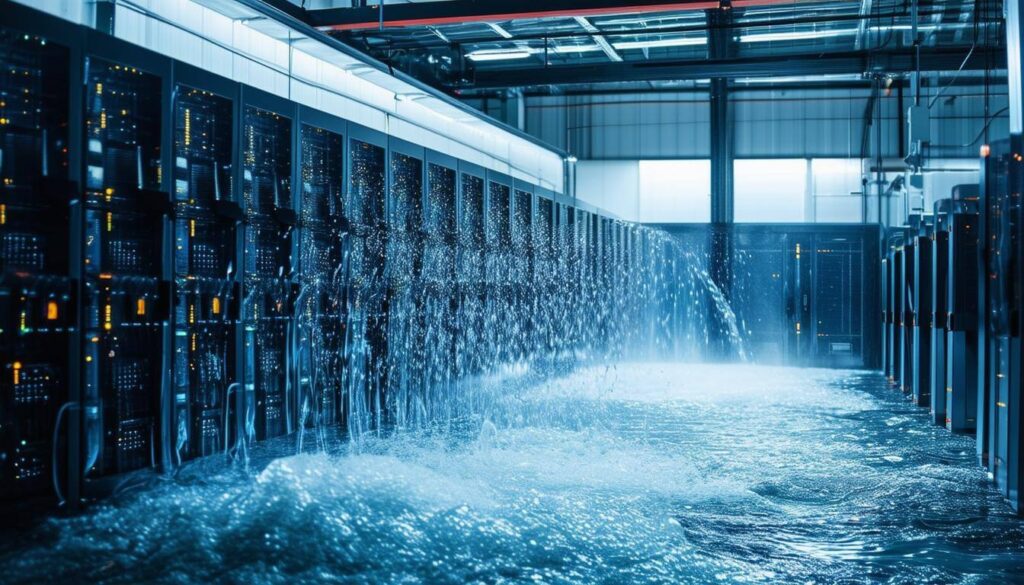
AI may live in the cloud, but it runs on very real machines. Every AI system depends on data centers packed with high-performance servers that generate enormous heat. To keep those systems operational, data centers rely heavily on water-based cooling.
This is where AI data center water usage comes into play. Cooling towers, chillers, and evaporative systems often consume vast amounts of freshwater to regulate temperatures. Without water, servers overheat—and AI simply stops working.
In other words, AI isn’t just powered by electricity. It’s powered by water.
Fact 2: Does AI Use Water Every Time You Ask a Question?
The short answer is yes—indirectly.
Every AI prompt activates processors that draw power and generate heat. That heat triggers cooling systems, many of which rely on water. One prompt may use a negligible amount, but AI operates at massive scale. Billions of queries per day across chatbots, image generators, and voice assistants turn tiny individual costs into significant cumulative water demand.
So when people ask, “does AI use water?”, the honest answer is that every interaction contributes to overall AI water consumption, even if users never see it.
Fact 3: Training AI Models Is Where Water Use Spikes
While everyday AI usage matters, the biggest water footprint often comes from training large AI models. Training can take weeks or months, running powerful GPUs around the clock.
During this process:
- Servers operate continuously at high intensity
- Cooling systems run nonstop
- Electricity generation itself may require water, depending on the energy source
Experts estimate that a single large-scale AI training run can consume millions of liters of water, sometimes comparable to the annual water use of small towns. As AI models grow larger and more complex, this part of AI water consumption is rising rapidly.
Fact 4: AI Water Consumption Is Growing Faster Than Transparency
Unlike carbon emissions, water usage by AI systems is rarely disclosed publicly. There are no universal standards requiring companies to report how much water their AI data centers consume.
This lack of transparency creates serious challenges:
- Communities may not know how much water local data centers use
- Facilities are sometimes built in water-stressed regions
- Policymakers struggle to regulate what they can’t measure
As AI demand accelerates, experts warn that unchecked growth in AI data center water usage could worsen regional water shortages—especially in areas already facing drought conditions.
Fact 5: Tech Companies Are Trying to Curb AI’s Thirst
Not all developments are negative. Facing growing scrutiny, major technology companies are experimenting with ways to reduce AI’s water footprint.
Some of the strategies include:
- Air-based or liquid-immersion cooling systems
- Closed-loop cooling that recycles water instead of consuming freshwater
- Building data centers in cooler climates to reduce cooling demand
Companies like Google and Microsoft have publicly committed to water-positive or water-efficient initiatives. However, analysts note that these efforts must scale quickly to keep pace with AI’s explosive growth.
Why AI’s Water Use Matters More Than Ever
Water scarcity already affects billions of people worldwide. As AI becomes embedded in search engines, education platforms, healthcare systems, entertainment apps, and workplace tools, its environmental footprint expands alongside its usefulness.
Understanding how does AI use water is no longer a niche concern. It’s a central sustainability issue tied to:
- Climate resilience
- Urban water planning
- Ethical AI development
Without careful management, AI’s success could unintentionally place new pressure on one of the planet’s most limited resources.
What Comes Next?
Experts expect AI’s water footprint to face increasing scrutiny in the coming years. Likely next steps include:
- Calls for mandatory water-usage disclosure
- Greater regulatory oversight of data center expansion
- Investment in water-efficient AI infrastructure
For now, the convenience of AI tools comes with a hidden cost—one that flows quietly through pipes and cooling towers far from the user’s screen.
As AI reshapes the future, the conversation is shifting from what AI can do to what it costs the planet. And when it comes to AI water consumption, that cost is becoming impossible to ignore.
The Real Cost Behind “Free” AI Tools
So, how does AI use water? Through cooling systems, energy generation, and nonstop computation that keeps modern AI alive.
AI may feel digital, but its environmental footprint is very real. Understanding AI water consumption is the first step toward building a future where innovation doesn’t come at the planet’s expense.