
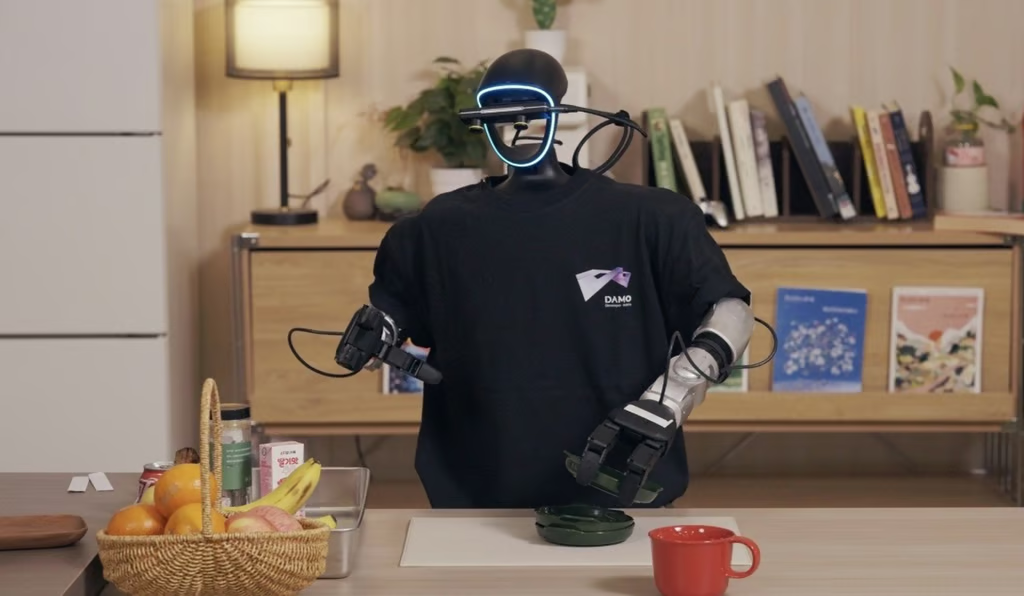
Alibaba has officially stepped into the physical AI arena with the launch of the Alibaba RynnBrain robot model, an open-source system designed to power intelligent robots capable of perceiving environments and executing real-world tasks.
While most AI headlines focus on chatbots, the Alibaba RynnBrain robot model signals a strategic shift toward machines that don’t just talk — they act.
Alibaba RynnBrain Robot Model Enters the Physical AI Race
The Alibaba RynnBrain robot model was unveiled this week as an open-source platform, allowing developers worldwide to experiment, adapt and deploy it in robotics applications. The move mirrors Alibaba’s earlier open approach with its Qwen language models, which have become some of China’s most advanced AI systems.
Video demonstrations released by Alibaba’s DAMO Academy show robots powered by the Alibaba RynnBrain robot model identifying fruit and placing it into baskets. While simple on the surface, such actions require advanced object recognition, spatial reasoning and precise motor coordination.
The model falls into the category of vision-language-action (VLA) systems, integrating computer vision, natural language processing and motor control. Unlike traditional robots that follow preprogrammed instructions, the Alibaba RynnBrain robot model enables machines to adapt behavior in real time based on environmental feedback.
From Automation to Autonomous Decision-Making
The introduction of the Alibaba RynnBrain robot model reflects a broader transformation in robotics. Physical AI systems are shifting from rigid automation toward autonomous decision-making in dynamic environments.
According to Deloitte’s 2026 Tech Trends report, physical AI is moving from a research phase into industrial deployment. Simulation platforms and synthetic data generation are accelerating development cycles before real-world implementation.
The shift is not purely technological — it’s economic. Ageing populations and labour shortages across advanced economies are pushing companies to adopt machines that can supplement or replace human labor in logistics, manufacturing and infrastructure.
China, Japan and South Korea are already confronting demographic pressures that make robotics adoption a strategic necessity rather than a choice. In that context, the Alibaba RynnBrain robot model positions China at the forefront of large-scale physical AI experimentation.
The Multitrillion-Dollar Opportunity
The physical AI race is increasingly framed as a high-stakes industrial competition. Nvidia CEO Jensen Huang has described robotics and physical AI as a “multitrillion-dollar growth opportunity.”
Companies including Nvidia, Google DeepMind and Tesla are investing heavily in AI-driven robotics. Nvidia has introduced its Cosmos models, Google DeepMind offers Gemini Robotics-ER 1.5, and Tesla is developing AI for its Optimus humanoid robot.
However, the Alibaba RynnBrain robot model stands out for its open-source strategy. By making the system freely available, Alibaba may accelerate ecosystem development and adoption at scale.
UBS estimates there could be two million humanoid robots in workplaces by 2035, rising to 300 million by 2050. That represents a total addressable market between $1.4 trillion and $1.7 trillion by mid-century.
The Governance Challenge
As capabilities expand, governance is becoming the binding constraint. A World Economic Forum analysis this week warned that physical AI failures cannot be “patched” after deployment the way software errors can.
When robots operate in factories, warehouses or public environments, mistakes carry operational, safety and liability consequences. Governance frameworks must define risk tolerance, system controls and frontline override authority.
The analysis identifies three layers of governance: executive oversight to set risk boundaries, system governance embedding stop rules and safeguards, and frontline governance giving workers authority to intervene.
The Alibaba RynnBrain robot model enters this environment at a time when governance standards remain fragmented globally.
Early Deployments Signal Momentum
Across industries, physical AI adoption is accelerating. Amazon recently deployed its millionth robot, coordinated by its DeepFleet AI system. BMW is testing humanoid robots for precision manipulation tasks. Cities like Cincinnati are deploying AI-powered drones for infrastructure inspections, while Detroit has launched autonomous shuttle services.
South Korea this week announced a $692 million initiative to develop AI semiconductors, underscoring that robotics leadership depends not only on software but also on chip manufacturing capacity.
The Alibaba RynnBrain robot model arrives amid this intensifying global competition. China’s faster deployment cycles may provide an early learning advantage, though governance models tested in controlled industrial settings may face challenges in public environments.
A Strategic Inflection Point
With the launch of the Alibaba RynnBrain robot model, the physical AI race has entered a new phase. The conversation is shifting from whether robots can operate autonomously to whether nations and companies can govern them responsibly at scale.
For Alibaba, open-sourcing RynnBrain could accelerate adoption and ecosystem growth. For the broader industry, the key question is no longer technical feasibility — it is strategic leadership in a world where AI does not just compute, but moves.

Don’t miss out on our latest news—follow us for the latest AI news, breakthroughs, and insights that matter.