

OpenAI has officially rolled out the ChatGPT group chat pilot in four Asia-Pacific regions — Japan, New Zealand, South Korea, and Taiwan — marking one of its biggest steps toward making ChatGPT feel more like a shared, social experience rather than a one-on-one AI tool.
The ChatGPT group chat pilot is available right now to Free, Plus, and Team users across both mobile and desktop. While the feature is still in early testing, OpenAI says it wants to observe how people collaborate inside ChatGPT before expanding the rollout to more countries.
This new update follows earlier leaks hinting that OpenAI was experimenting with direct-messaging-style functionality. Now, the company describes the ChatGPT group chat pilot as a “small first step” toward more community-driven interactions inside the app. Early testers will influence how the feature evolves, including how group dynamics and shared workflows are handled.
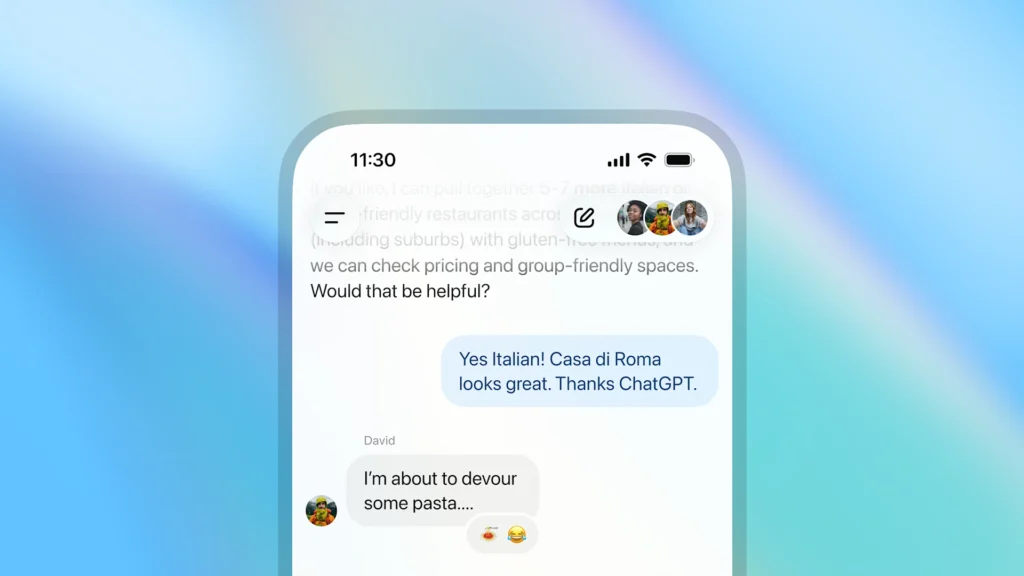
A Private, Controlled Way to Collaborate
OpenAI emphasizes that private chats and ChatGPT’s memory remain untouched. The ChatGPT group chat pilot uses invitation-only rooms that can host between 1 and 20 participants. Anyone in the group — except the creator — can remove others, but leaving the group is always optional.
For users under 18, OpenAI has added extra guardrails, content filtering, and parental controls, a continuation of its trend toward more supervised AI usage for minors.
How the Group Chats Work
Starting a group inside the ChatGPT group chat pilot is simple: tap the people icon, add participants directly or share an invite link, and you’re ready to go. If you add someone to an existing conversation, ChatGPT automatically spins up a brand-new group while keeping the original chat intact.
Every group has a short profile, and conversations are neatly organized in a labeled sidebar for easy navigation.
Functionally, group chats behave just like regular ChatGPT conversations — with one key difference: multiple humans can participate at once. The AI only jumps in when needed. ChatGPT now has “social awareness,” meaning it tries to read the room: it won’t interrupt unless tagged or directly invited into the conversation.
GPT-5.1 Auto powers the responses, offering all the usual tools like search, image generation, voice dictation, and file uploads. Importantly, usage limits only apply when ChatGPT itself replies, not when humans are talking to each other.
More Personality, More Fun
The ChatGPT group chat pilot isn’t just functional — it’s social. The AI can now react with emojis, create personalized images using participants’ profile photos, and match the tone of the group. This is part of OpenAI’s broader shift toward making ChatGPT feel more human, more expressive, and more useful in collaborative settings.
Part of a Larger Push Toward Social AI
This pilot reflects OpenAI’s gradual transition from a pure AI assistant toward something resembling a social platform. In late September, the company launched Sora 2, a standalone app combining AI-generated video feeds with social features like DMs and algorithmic recommendations.
The ChatGPT group chat pilot appears to be the next step in that evolution — bringing human-to-human collaboration and AI-assisted discussions under one roof.
As the pilot rolls out and user feedback pours in, OpenAI plans to refine the experience before expanding globally. For now, early testers get the first taste of what could become one of ChatGPT’s most transformative updates yet.

Don’t miss out on our latest news—follow us for the latest AI news, breakthroughs, and insights that matter.