

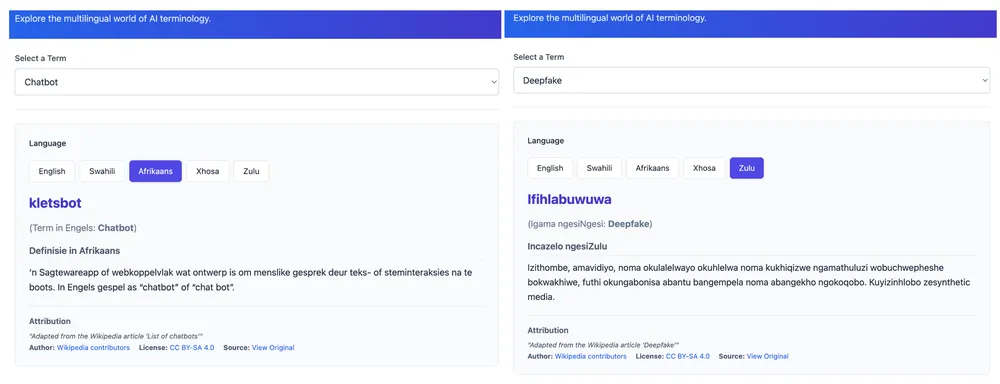
In a major step toward digital inclusivity, Google has launched its AI Glossary in isiZulu, isiXhosa, and Afrikaans, giving millions of South Africans the opportunity to understand artificial intelligence in their native languages.
The expansion, developed in partnership with the Pan South African Language Board (PanSALB) and Twaweza Communications, builds on Google’s ongoing effort to make AI education more accessible across Africa.
Breaking the Language Barrier in AI
The Google AI Glossary features 100 key terms related to artificial intelligence — from “conversational AI” and “hallucination” to “active learning” and “noisy data.” Each term has been standardized and translated with input from linguists, AI experts, and academic stakeholders to ensure cultural and contextual accuracy.
“In Africa, English often dominates conversations around technology and science,” Google explained in its release. “By offering the AI Glossary in local languages, we’re empowering more people to take part in shaping the future of AI.”
Partnerships for Precision and Relevance
The collaboration with PanSALB and Twaweza Communications involved a series of workshops and roundtable discussions with linguists, lexicographers, and developers. This process ensured that the AI terms were not merely translated but adapted for meaning, clarity, and relevance in each local language.
Empowering Local Communities
Google’s Country Director, Kabelo Makwane, emphasized that the initiative aligns with Google’s mission to democratize technology:
“We want everyone to have the words to understand and shape the technologies that are changing the world.”
Access and Availability
The Google AI Glossary is freely available on GitHub, making it a vital resource for educators, translators, policymakers, and developers across the continent.
This move follows Google’s earlier release of a Swahili AI Glossary in East Africa, signaling a long-term commitment to building inclusive AI literacy in the Global South.
As AI becomes increasingly integrated into education, commerce, and governance, Google’s localization push may redefine how non-English speakers engage with — and contribute to — the global AI conversation.