

GPT-5.3-Codex is OpenAI’s newest coding-focused AI model—and it’s already reigniting debates about how close the industry is to true self-improving machines.
On Thursday, OpenAI unveiled GPT-5.3-Codex, describing it as roughly 25% faster than its predecessor while delivering stronger performance across internal benchmarks. But the technical gains weren’t what grabbed the internet’s attention.
Instead, it was OpenAI’s claim that GPT-5.3-Codex was the first model that was “instrumental in creating itself.”
Did GPT-5.3-Codex Really Build Itself?
The phrase immediately set off speculation online. For some, it sounded like a step toward recursive self-improvement—the long-theorized moment when AI systems continuously rewrite their own code and rapidly surpass human intelligence.
The reality, however, is far less dramatic.
In follow-up explanations, OpenAI clarified that GPT-5.3-Codex was used to accelerate parts of its own development, not to autonomously design or train a new model from scratch. According to the company, early versions of Codex helped engineers debug training runs, manage deployment workflows, and diagnose evaluation results.
In short, GPT-5.3-Codex acted as a powerful assistant for human developers—not an independent AI architect.
Online Reactions Swing Between Hype and Humor
Even so, the wording was enough to ignite imaginations.
On Reddit’s r/singularity forum, reactions ranged from tongue-in-cheek anxiety to full-blown sci-fi speculation. One commenter joked, “I hope everyone remembers how good a mid-level manager I was before the machines came.” On X, an AI newsletter writer declared, “Holy moly — so it begins!”
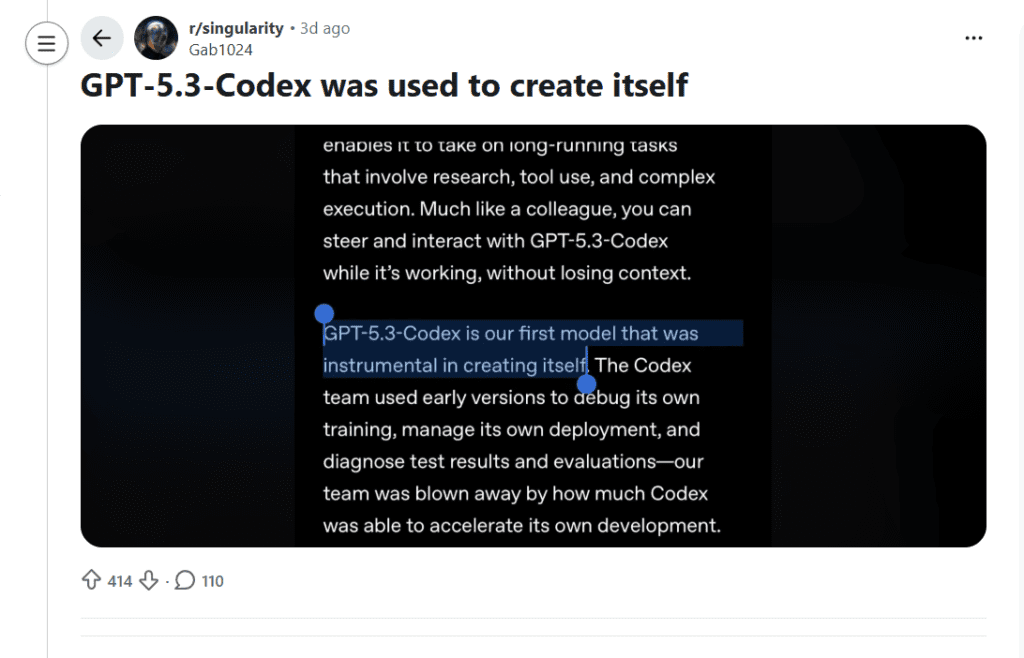
The reaction highlights how discussions around AI remain heavily shaped by science fiction narratives, where even incremental advances are framed as existential milestones.
Not an Isolated Claim in the AI World
OpenAI isn’t alone in leaning into bold language. Last month, Anthropic stirred similar debate when Claude Code lead Boris Cherny claimed that “pretty much” all of the company’s code is now AI-generated using its own models.
As with GPT-5.3-Codex, what that actually looks like in practice remains opaque—and still far removed from the idea of AI systems operating without sustained human oversight.
Sam Altman’s ‘Vibe-Coding’ Moment
The GPT-5.3-Codex launch also coincided with a personal reflection from Sam Altman, who shared that using Codex left him feeling unexpectedly… replaceable.
Altman tweeted that after building an app with Codex and asking it to suggest new features, the model proposed ideas better than his own. “I felt a little useless and it was sad,” he wrote—an anecdote that perfectly captures the uneasy mix of excitement and insecurity surrounding modern AI tools.
What GPT-5.3-Codex Actually Signals
Despite the hype, GPT-5.3-Codex doesn’t mark the arrival of self-evolving AI. What it does show is how advanced models are becoming deeply embedded in the software development lifecycle, assisting humans at nearly every stage—from debugging to evaluation.
That’s impressive, and potentially transformative for productivity. But it’s still a long way from machines that design, train, and deploy successors entirely on their own.
For now, GPT-5.3-Codex is best understood not as the beginning of the singularity—but as another step toward AI systems that help humans build faster, smarter, and sometimes with a slightly bruised ego.

Don’t miss out on our latest news—follow us for the latest AI news, breakthroughs, and insights that matter.