

OpenAI is officially entering the browser wars — and it’s not holding back. During a high-profile livestream, the company unveiled OpenAI Atlas Browser, its new AI-powered browser built to make ChatGPT your primary gateway to the internet.
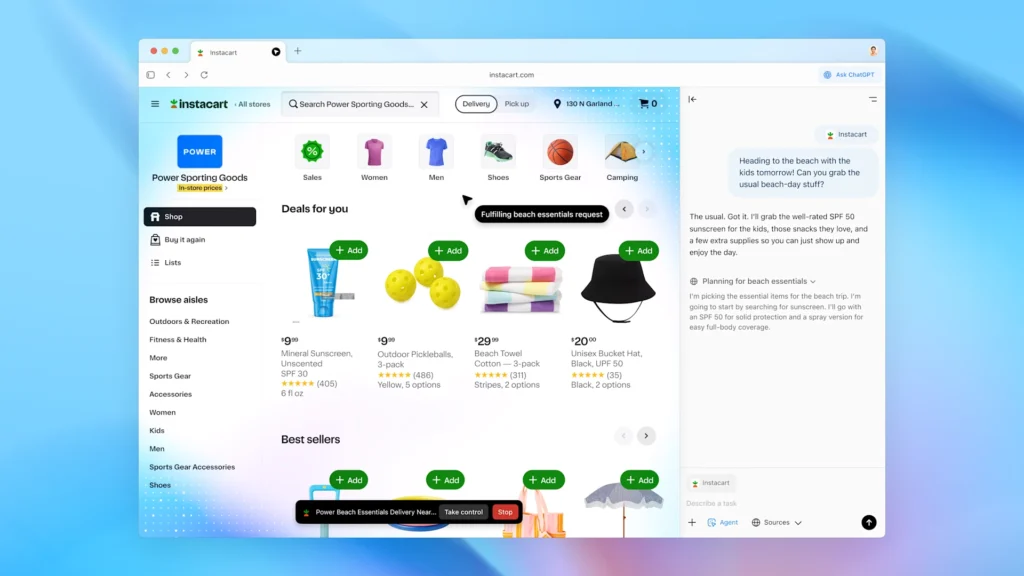
Unlike traditional browsers like Chrome or Safari, OpenAI Atlas Browser doesn’t just take you to web pages — it lets ChatGPT interpret, summarize, and interact with them for you. OpenAI’s goal? To keep ChatGPT at the center of your online life, rather than simply making web browsing better.
Currently available for Mac users, Atlas will soon roll out across Windows, iOS, and Android, seamlessly syncing with existing ChatGPT experiences. Unlike competing AI browsers such as Opera’s Neon, The Browser Company’s Dia, or Perplexity’s Comet, Atlas doesn’t use an invite-only model — anyone can download it.
Redefining Search: Goodbye Google, Hello OpenAI Atlas Browser
At its core, Atlas changes how we think about search. Instead of typing into Google and sifting through endless results, users can now type directly into the browser’s address bar, and ChatGPT instantly provides summarized answers.
“We think AI represents a once-in-a-decade opportunity to rethink what a browser can be,” said OpenAI CEO Sam Altman at the launch. “Tabs were great, but there hasn’t been a lot of innovation since then.”
This new OpenAI Atlas browser turns ChatGPT into your personal search assistant, reducing the need to visit multiple sites for answers. It’s not just a browser — it’s an extension of the ChatGPT experience itself.
Atlas Tightens OpenAI’s Grip on Distribution
For OpenAI, Atlas is more than a browser — it’s a strategic move. With companies like Meta restricting third-party chatbot integrations (including ChatGPT) on platforms like WhatsApp, OpenAI is securing its own channel to users.
By owning the browser layer, OpenAI ensures ChatGPT can reach users directly, without depending on tech giants like Google, Apple, or Microsoft — who control most of today’s digital access points.
Deep ChatGPT Integration: Memory, Apps, and Context
Atlas goes beyond search. It integrates ChatGPT’s memory feature, allowing it to recall your browsing history and chat context. You can ask things like, “What was the site with my presentation plan?”, and Atlas will fetch it instantly.
This gives ChatGPT a powerful new advantage — a complete understanding of your browsing and conversation habits, enabling it to offer hyper-personalized responses.
Additionally, Atlas supports OpenAI’s App SDK, meaning developers can build tools directly within ChatGPT — turning the browser into a multi-app workspace.
A Smarter Browser — But Not Necessarily a Better One
Interestingly, OpenAI Atlas Browser skips some features that modern users expect. It doesn’t include an ad-blocker, VPN, translation tool, or reading mode. Instead, users are encouraged to ask ChatGPT to perform tasks like summarizing pages or translating text.
That design choice shows what OpenAI truly wants — to make every action flow through ChatGPT, giving it more context and user data.
In contrast, browsers like Arc offer user-centered features like automatic file renaming and web page customization — proving there’s still a difference between an AI-first browser and a user-first browser.
OpenAI’s Vision: ChatGPT as the Operating System for Your Life
Fidji Simo, OpenAI’s CEO of Applications, summed it up perfectly in her launch blog:
“ChatGPT needs to become so much more than the chatbot it started as. Over time, we see ChatGPT evolving into the operating system for your life — a connected hub that helps you manage your day and achieve your long-term goals.”
Atlas is a major step in that direction — merging browsing, searching, writing, and AI assistance into a single experience.
The Big Question: Will Users Switch?
The challenge is enormous. Convincing billions of Chrome and Safari users to change habits won’t be easy. Chrome succeeded because it was fast and intuitive — people naturally wanted Google as their starting point.
Atlas, meanwhile, is perfect for users who have already replaced Google with ChatGPT. For everyone else, OpenAI must prove that an AI-first browsing experience is not just novel — but genuinely better.
Key Takeaway
OpenAI Atlas Browser isn’t just another browser — it’s a bold statement. It’s about keeping ChatGPT at the heart of the web, reshaping how we search, consume, and interact online. Whether it can unseat giants like Google and Apple remains to be seen, but one thing’s certain — the future of browsing just got a lot more intelligent.