

OpenAI has officially introduced OpenAI Frontier, a new enterprise-focused platform designed to help organizations build, deploy, and manage AI agents at scale. Announced on February 5, the platform is now live for a select group of customers, with broader availability planned in the coming months.
According to OpenAI, the biggest obstacle holding enterprises back is no longer model capability—but execution. Advanced AI systems are already powerful, yet many organizations struggle to operationalize them across complex, regulated, and fragmented environments. OpenAI Frontier is positioned as the missing layer that turns AI agents from promising demos into dependable digital coworkers.
From Powerful Models to Production-Ready Agents
OpenAI says it has observed a widening gap between what AI models can do and what enterprises are actually able to deploy in production. Internal data cited by the company shows that 75% of enterprise workers report AI has helped them complete tasks they previously couldn’t—but scaling those gains remains difficult.
Early adopters of OpenAI Frontier include major enterprises such as HP, Intuit, Oracle, State Farm, Thermo Fisher Scientific, and Uber. Existing OpenAI customers like BBVA, Cisco, and T-Mobile have also piloted the platform to support more complex, multi-agent deployments.
“What’s slowing teams down isn’t intelligence,” OpenAI noted in its announcement. “It’s how agents are built, governed, and operated inside organizations.”
A Unified System for AI Agents at Work
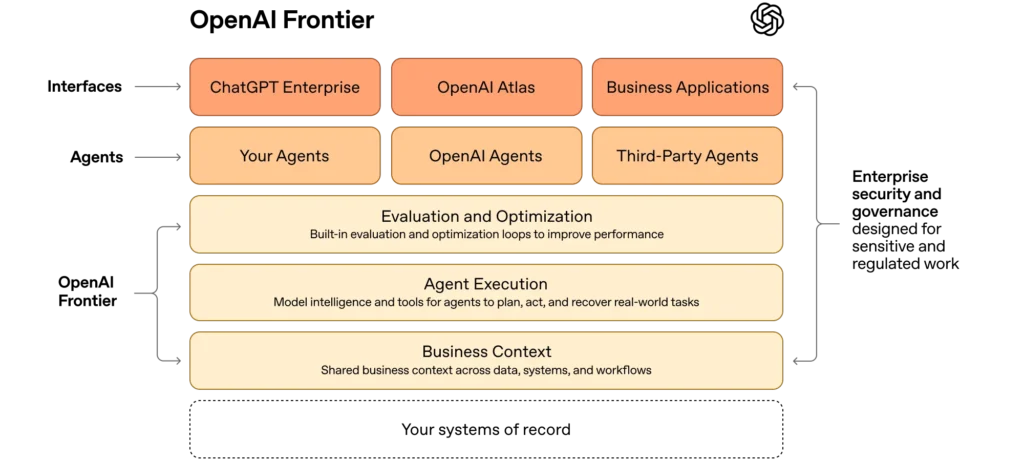
At its core, OpenAI Frontier is designed as an end-to-end operating system for AI agents. Instead of deploying isolated agents across different tools and clouds, enterprises can use Frontier to give agents shared context, memory, identities, and permissions—mirroring how companies onboard and manage human employees.
The platform introduces a shared semantic layer that connects enterprise systems such as data warehouses, CRM platforms, ticketing tools, and internal applications. This allows AI agents to understand how work flows across an organization, rather than operating in silos.
With that context, agents can plan and execute tasks like analyzing files, running code, investigating issues, and interacting with enterprise tools—all within controlled execution environments.
Built for Governance, Security, and Scale
Security and governance are central to OpenAI Frontier’s design. Each agent is assigned a defined identity with specific permissions and guardrails, making the platform suitable for regulated industries. Built-in evaluation and optimization tools allow teams to continuously measure performance and refine agent behavior as workflows evolve.
OpenAI says this structure helps agents build memory over time, learning from past interactions to improve outcomes without sacrificing oversight.
One example shared by the company involved hardware testing and root cause analysis. In that case, AI agents reduced investigation times from roughly four hours per failure to just minutes by analyzing logs, documentation, workflows, and code in parallel.
Forward-Deployed Engineers and an Open Ecosystem
To accelerate adoption, OpenAI pairs enterprise customers with Forward Deployed Engineers—specialists who work directly with internal teams to bring AI agents into production. Feedback from these deployments is also used to inform future platform and model development.
OpenAI Frontier is also being positioned as an open ecosystem. The company is collaborating with AI-native partners including Abridge, Clay, Ambience, Decagon, Harvey, and Sierra, with plans to expand the partner network over time.
By supporting open standards and existing enterprise systems, OpenAI says Frontier avoids forcing customers into costly replatforming efforts—one of the biggest barriers to AI adoption at scale.
Why OpenAI Frontier Matters
As enterprises move from experimenting with AI to relying on it for mission-critical work, platforms like OpenAI Frontier could define how agents are deployed responsibly and effectively. Rather than focusing solely on smarter models, OpenAI is betting that the next wave of enterprise value will come from better orchestration, governance, and integration.
If that bet pays off, OpenAI Frontier could become the backbone for how AI agents actually get work done inside large organizations.

Don’t miss out on our latest news—follow us for the latest AI news, breakthroughs, and insights that matter.