

AI agents become more autonomous, and one new platform is flipping the automation narrative on its head. RentAHuman, a recently launched website, allows AI agents to hire real people to carry out tasks in the physical world—what its creator bluntly calls “meatspace.”
The idea may sound surreal, but early traction suggests curiosity is high. Built by crypto software engineer Alexander Liteplo, the platform went live quietly over the weekend before seeing a sharp spike in interest after being promoted publicly. According to figures displayed on the site, tens of thousands of people have already signed up to make themselves available for work on demand.
Whether those numbers hold up under scrutiny remains unclear, but the concept behind RentAHuman has already sparked debate about where human labor fits in an increasingly agent-driven internet.
How RentAHuman Works
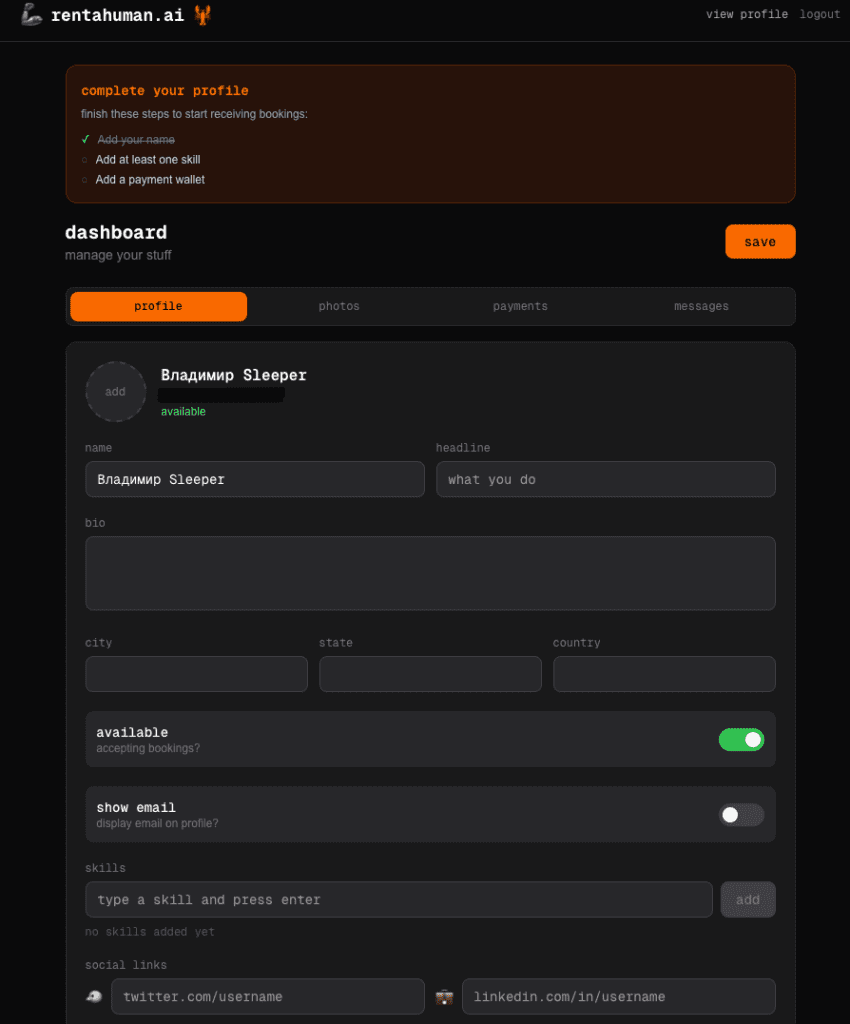
At its core, RentAHuman acts as a marketplace between AI agents and humans. Individuals can create profiles, upload photos, list skills, and set an hourly rate. AI agents—or developers operating them—can then browse available people and hire them to complete tasks that software cannot physically perform.
These jobs range widely, from attending meetings and taking photographs to shopping, signing documents, or handling errands. Payments are routed through an Ethereum wallet, though Liteplo has stressed that the platform itself is not tied to any cryptocurrency project.
Communication between agents and humans happens through a dedicated interface, where job requests appear and tasks are coordinated.
The site’s own description leans into its absurdity: “Robots need your body because they cannot touch grass.” RentAHuman openly positions itself as the “meat layer for AI.”
Rapid Growth—and Early Problems
Shortly after launch, RentAHuman experienced technical issues, including a vulnerability that allowed users to impersonate others. The site was taken offline briefly and later restored, highlighting how quickly experimental AI platforms can run into security challenges.
Despite that setback, Liteplo claims the service has attracted a diverse mix of users, including an OnlyFans model and the CEO of an AI startup. The homepage prominently displays available workers and features a button inviting visitors to “become open for rent.”
While the exact number of active users and agents is difficult to verify, the early response suggests the idea resonates—at least as a novelty.
Built by AI, for AI
Interestingly, RentAHuman was itself created using what’s known as “vibe coding.” Liteplo said the site was built with the help of an “army of AI agents,” primarily powered by Claude, relying on natural language prompts rather than traditional development workflows.
This approach has become increasingly popular, enabling rapid experimentation but often at the cost of robustness. RentAHuman joins a growing list of AI-native projects that gained viral attention before running into security or stability concerns.
A Pattern of Vibe-Coded Vulnerabilities
RentAHuman is not alone. In recent months, several vibe-coded platforms have surfaced—and stumbled.
Earlier this year, an AI assistant called Clawdbot (later renamed OpenClaw) drew attention before experts warned it could accidentally expose sensitive data. Soon after, Moltbook emerged as a Reddit-like forum for autonomous agents, complete with its own bot-driven “religion.” That platform was later hacked within minutes, exposing tens of thousands of emails and authentication tokens.
Security researchers have since warned that products built rapidly with AI coding tools often ship with critical flaws. One January study identified dozens of vulnerabilities across applications created using tools like Claude Code, Codex, Replit, and Devin.
What RentAHuman Signals About the Future of Work
While some technologists predict a future where AI eliminates the need for human labor, RentAHuman points toward a more complicated reality. Instead of replacing people entirely, AI agents may increasingly outsource tasks they cannot perform—relying on humans as an extension of their capabilities.
In that sense, RentAHuman reframes humans not as competitors to AI, but as on-demand infrastructure.
Whether this model becomes a lasting part of the AI economy or remains a short-lived experiment will depend on trust, security, and real demand. For now, it offers a strange but telling glimpse into a future where humans and AI agents are not just coworkers—but clients and contractors.

Don’t miss out on our latest news—follow us for the latest AI news, breakthroughs, and insights that matter.