

Imagine starting a new job where your onboarding, coaching, and even early interviews are handled by a lifelike digital human. That future may be nearer than expected. AI avatars for training are at the center of Synthesia’s next growth phase, as the London-based startup doubles down on enterprise use cases.
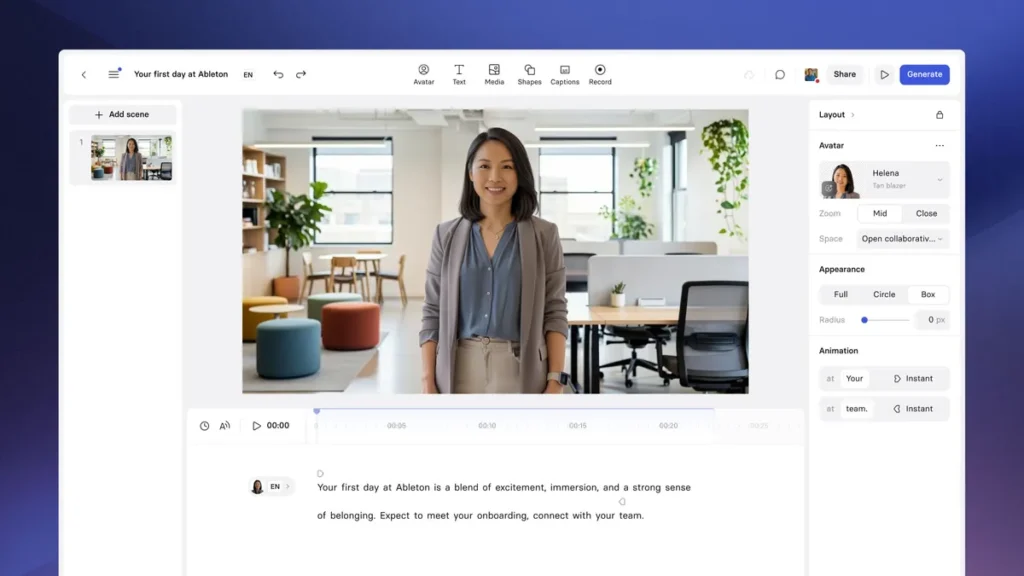
Synthesia, known for turning text scripts into realistic video presenters, is now building interactive audio-visual AI agents—avatars capable of holding conversations, answering questions, and guiding employees through role-specific scenarios. The company says sales training will be the first major use case, followed by recruiting, coaching, and broader corporate communications.
$200 Million Funding Signals Enterprise Confidence
To accelerate that vision, Synthesia has raised $200 million in fresh funding at a $4 billion valuation, nearly doubling its valuation from a year ago. The round was led by GV, with participation from existing backers Nvidia and Accel, alongside new investors Hedosophia and Evantic Capital.
The financing includes a tender offer for employees and positions Synthesia among the most valuable AI startups in the UK.
Why AI Avatars for Training Matter Now
According to CEO Victor Riparbelli, enterprises are under pressure to continuously upskill workers—but human-led training doesn’t scale easily.
“Companies want automation for upskilling,” Riparbelli said. “But coaching, feedback, and role-playing still rely heavily on people. That’s the gap we’re trying to close.”
By using this training, the company aims to automate repetitive learning interactions while keeping them engaging and personalized—something static videos and documents struggle to achieve.
From Scripts to Conversational AI Agents
The company’s new AI agents go beyond pre-written scripts. They are designed to understand context, answer follow-up questions, and stay within defined knowledge boundaries. In internal demos, the avatars handled complex sales training conversations, though the company admits the technology still has quirks—including the occasional need to repeat questions.
Still, customers appear interested. Synthesia has been piloting the agents with dozens of enterprise clients for several months.
A Key Test for Enterprise Generative AI
Synthesia is widely seen as a test case for whether generative AI can successfully sell into large organizations—a metric closely watched by investors. While AI hype has surged, few startups have proven sustained enterprise traction.
In April, Synthesia reported crossing $100 million in annual recurring revenue, a major milestone in SaaS. Riparbelli says that figure has since grown significantly, driven largely by demand in regulated sectors like finance, healthcare, and retail.
Major clients reportedly include Microsoft, UBS, and Ford.
Strategic Shift Away From Consumer Media
Interestingly, Synthesia has deliberately stepped away from consumer-facing AI content. The company once explored AI-generated advertising and even produced an avatar-based ad featuring football star Lionel Messi.
But Riparbelli says competing in social feeds is a losing game.
“That’s where a lot of competitors went bust,” he said. “Corporate communication is a much bigger, more durable market.”
This focus may explain why Synthesia, unlike many AI startups, has minimal presence in Silicon Valley and prioritizes enterprise sales over tech-sector buzz.
Competition and Valuation Discipline
In October, reports suggested Adobe held acquisition talks with Synthesia at around $3 billion, though Riparbelli declined to comment. He also revealed the company turned down higher valuation offers in favor of sustainable growth.
“Having a higher valuation might look cooler,” he said. “But I’d rather build a business I feel good about.”
Despite its growth, Synthesia is not yet profitable—a conscious choice, Riparbelli says, as the company continues to invest in product development and market expansion.
The Bigger Picture
As enterprises look for scalable ways to train, coach, and recruit talent, it may become a standard workplace tool rather than a novelty.
Whether Synthesia’s digital humans become as common as video conferencing will depend on trust, realism, and ROI—but with Nvidia backing and strong enterprise demand, the company is positioning itself at the forefront of AI-driven workplace transformation.

Don’t miss out on our latest news—follow us for the latest AI news, breakthroughs, and insights that matter.