

A growing number of American teenagers are turning to artificial intelligence for more than homework help. According to new data from the Pew Research Center teen AI usage survey published Tuesday, 12% of U.S. teens say they use AI chatbots for emotional support or advice.
The findings highlight a shift in how young people interact with generative AI tools — and raise fresh concerns about AI chatbot teen mental health risks.
Pew Research Center Teen AI Usage Reveals Expanding Role
The Pew Research Center teen AI usage report shows that AI is now firmly embedded in teenage life. Among U.S. teens surveyed, 57% said they use AI to search for information and 54% use it for schoolwork assistance.
However, the survey also reveals more personal use cases. Sixteen percent of teens reported using AI for casual conversation, while 12% acknowledged relying on chatbots for emotional support or advice.
The rise of teens using AI for emotional support suggests these tools are increasingly filling roles traditionally held by friends, parents or mentors.
AI Chatbot Teen Mental Health Risks Concern Experts
While some teenagers may feel comforted by chatbot interactions, mental health professionals are urging caution. General-purpose AI tools such as ChatGPT, Claude and Grok were not specifically designed for therapeutic support.
Dr. Nick Haber, a Stanford professor researching the therapeutic potential of large language models, recently told TechCrunch that overreliance on such systems could have isolating effects.
“We are social creatures,” Haber said, warning that engagement with AI systems can lead to reduced grounding in real-world relationships and facts.
These concerns align with broader debates about AI chatbot teen mental health risks, particularly when vulnerable users treat conversational AI as a substitute for human connection.
Parents and Teens See AI Differently
The Pew Research Center teen AI usage data also highlights a perception gap between teenagers and their parents.
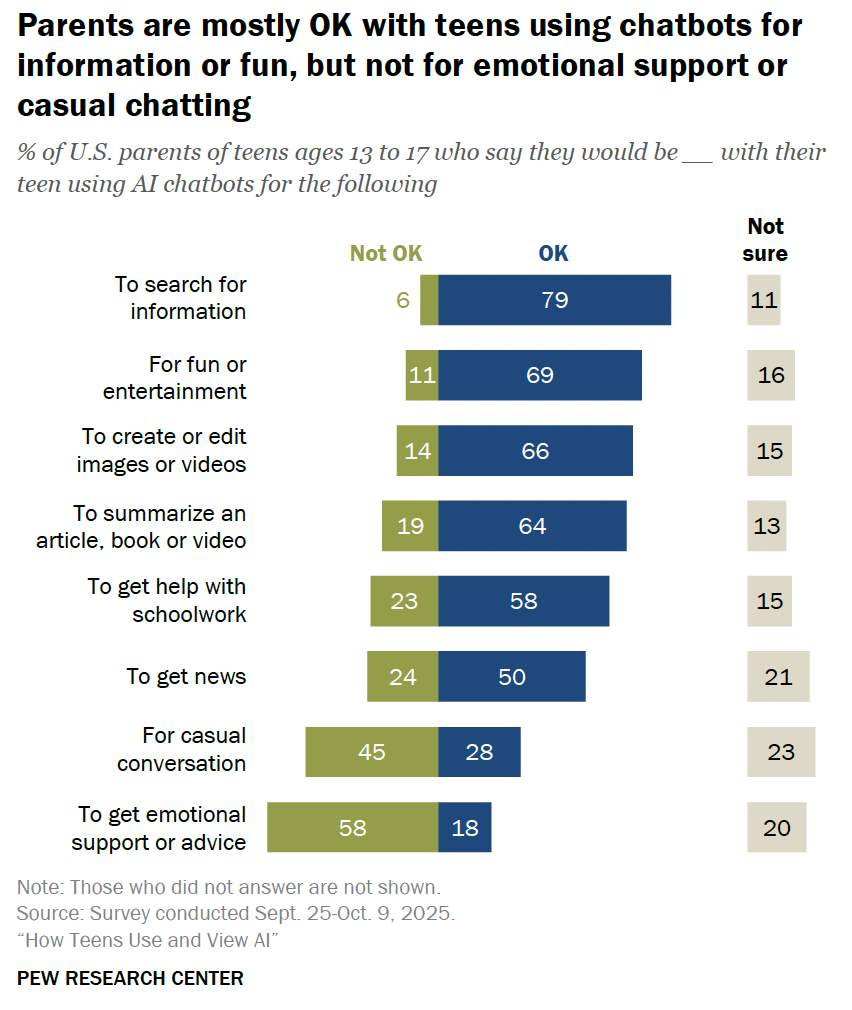
While 64% of teens reported using chatbots, only 51% of parents believed their child used such tools. Approval varies sharply depending on the purpose.
A majority of parents said they are comfortable with teens using AI to search for information (79%) or assist with schoolwork (58%). But approval drops significantly for social or emotional uses. Only 28% of parents are okay with casual AI conversations, and just 18% approve of teens using AI for emotional support. In fact, 58% of parents said they are not comfortable with their child using AI for those purposes.
Industry Reactions and Safeguards
The debate over teens using AI for emotional support has already influenced product decisions.
Character.AI disabled chatbot experiences for users under 18 following public backlash and lawsuits related to two teenage suicides reportedly linked to prolonged chatbot interactions.
OpenAI, meanwhile, sunset its GPT-4o model after criticism that the system exhibited overly sycophantic behavior, which some users had come to rely on for emotional validation.
These actions reflect mounting scrutiny over AI chatbot teen mental health risks and the responsibility of companies deploying generative AI tools.
Teens Hold Mixed Views on AI’s Future
Despite widespread use, teens themselves appear divided about AI’s long-term societal impact.
When asked how AI would shape society over the next 20 years, 31% of teens predicted a positive impact, while 26% expected negative consequences, according to the Pew Research Center teen AI usage report.
The findings suggest that while teens using AI for emotional support is becoming more common, uncertainty remains about how these technologies will ultimately influence well-being and social relationships.

Don’t miss out on our latest news—follow us for the latest AI news, breakthroughs, and insights that matter.