Great SEO isn’t just about keywords anymore — it’s about delivering a smooth, intuitive experience that keeps users engaged. AI-enhanced user experience SEO brings these two worlds together by using artificial intelligence to optimize how visitors interact with your site.
Google’s focus on Core Web Vitals and behavior signals means better UX directly improves rankings and engagement. AI helps achieve this by analyzing user intent, personalizing content, improving navigation and predicting what users want next — all in real time. Industry reports show that AI-powered UX changes often lead to higher engagement and more conversions, making this approach essential for modern SEO.
In the article, you’ll learn what this strategy really means, why it works and how to implement it step-by-step using proven tools and insights.
What Is AI-enhanced User Experience SEO?
AI-enhanced user experience SEO is the practice of using artificial intelligence to improve how users interact with your website — and in turn, improve your search rankings. Instead of relying only on traditional SEO tactics like keywords and backlinks, this approach focuses on delivering a smoother, more personalized experience that search engines recognize and reward.
At its core, AI analyses user behavior, intent and preferences, then adjusts elements of your site to make each visit feel intuitive. This includes faster load times, smarter content recommendations, improved navigation paths and even automated page optimizations based on real-time data.
AI doesn’t replace SEO — it strengthens it. By combining UX insights with search optimization, businesses get the best of both worlds: higher engagement from users and higher visibility on search engines.
Why Google Rewards Better User Experience: Key Ranking Signals
Google’s ranking system has evolved to favor websites that offer a smooth, satisfying experience. This is where AI-enhanced user experience SEO becomes a powerful advantage — because AI directly improves the very signals Google tracks.
Here are the core UX-driven ranking factors AI can strengthen:
1. Core Web Vitals (Speed, Stability, Interactivity)
Google measures how fast your page loads, how quickly users can interact, and whether the layout shifts unexpectedly. These signals show whether the browsing experience feels smooth or frustrating.
2. Content Relevance & Intent Match
AI helps identify what users truly want and ensures your content aligns with that intent. This drives deeper engagement and reduces bounce rates — two behaviors Google interprets as strong quality signals.
3. User Behavior Patterns
Metrics like time on page, scroll depth, and click-through paths tell Google whether users find your content helpful. AI-powered insights and personalization boost these behaviors by guiding visitors to what they need faster.
4. Mobile Experience & Accessibility
With mobile-first indexing, a frictionless mobile experience is non-negotiable. AI tools make it easier to optimize layouts, detect UX issue,s and tailor content to device types.
5. Navigation & Internal Linking Quality
Clear navigation improves crawlability and user flow. AI enhances this by suggesting smarter internal links and adaptive navigation paths based on user behavior.
When you combine these elements with AI for user experience optimisation, you get an SEO strategy that improves both user satisfaction and search rankings. In the next section, we’ll break down exactly how AI-enhanced user experience SEO leads to higher engagement — with practical examples you can apply immediately.
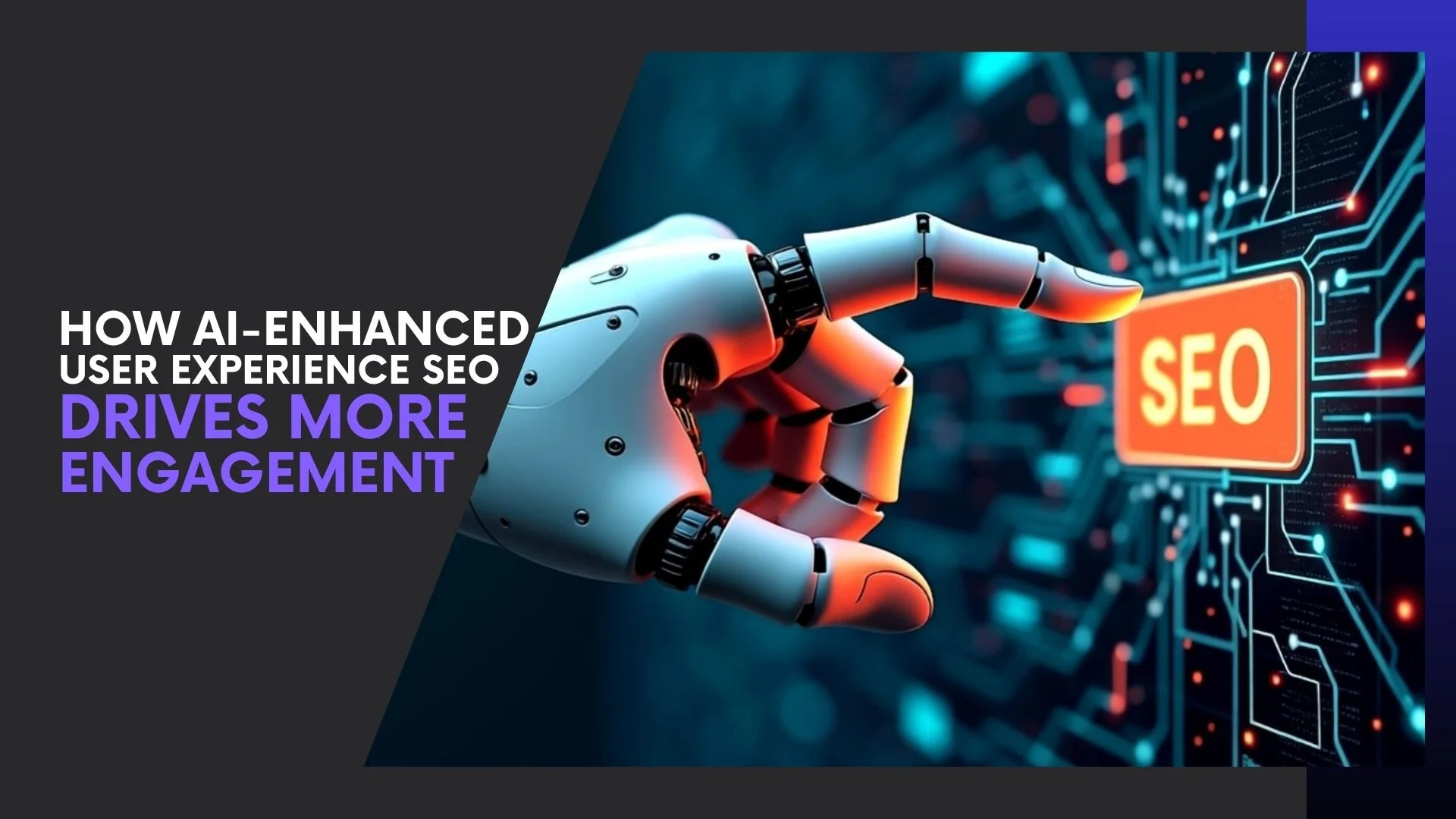
How AI-enhanced User Experience SEO Drives More Engagement
AI doesn’t just improve technical SEO — it transforms how users interact with your website. By understanding behavior, intent and preferences, AI creates experiences that feel faster, smoother and more relevant. This is where AI-enhanced user experience SEO becomes a true engagement booster.
Here’s how AI drives measurable improvements in user engagement:
1. Real-Time Personalization That Feels Natural
AI analyzes browsing patterns and instantly adapts content, product suggestions or article recommendations. Visitors see what matters to them, not generic content — reducing bounce rates and increasing time on page.
2. Smarter Content Relevance Through Intent Detection
AI tools identify what users really mean when they search. This helps you fine-tune content so it answers questions more accurately. When intent matches content, users stay longer and interact more.
3. AI-Optimized Navigation That Reduces Friction
By studying click paths and drop-off points, AI highlights where users struggle. You can then streamline menus, refine internal linking or reorganize layouts — making it easier for users to find what they want.
4. Predictive UX Enhancements Based on Behavior Trends
AI forecasts user actions and adjusts elements such as CTAs, content placement and layout for better engagement. Over time, even small changes compound into higher conversion rates.
5. Improved Interactivity and Faster Performance
AI-powered CDNs, caching systems and UX automation tools enhance speed and stability. Faster sites earn more clicks and more engagement — essential for SEO user experience improvement with AI.
6. Higher CTR with AI-Generated CTAs and On-page Elements
AI tools optimize headlines, CTAs and visual placements to capture attention at the right moment, lifting click-throughs and engagement rates.
Together, these enhancements create an experience that feels effortless for users — and compelling for search engines.
Top AI-Powered Techniques to Improve User Experience for SEO
AI gives you the ability to understand user behavior at scale, automate improvements and tailor your site dynamically — all of which support stronger rankings. Below are the most impactful techniques you can start using to elevate both UX and search performance. Each one naturally supports your strategy for AI-enhanced user experience SEO.
1. Dynamic Personalization for Content & Layouts
AI adjusts on-page content based on user behavior, location, device and past interactions.
Examples:
- Personalized product suggestions
- Tailored reading recommendations
- Dynamic homepage layouts
This keeps visitors engaged — and more engagement signals better relevance to Google.
2. Heatmap & Session Analysis Powered by AI
Tools now analyze heatmaps, scroll behavior and rage clicks automatically.
AI identifies:
- Drop-off zones
- Poorly performing CTAs
- Confusing navigation paths
- Elements causing user frustration
This is essential for AI for user experience optimisation because it reveals real issues instantly.
3. Automated A/B Testing at Scale
AI tests headlines, CTAs, images and layouts simultaneously and selects the winning versions.
You get:
- Better click-through rates
- Less guesswork
- Faster UX improvements
4. Predictive UX Modeling
AI forecasts what users are likely to do next and analyzes paths that lead to conversions.
Use cases include:
- Predicting which content users will read next
- Identifying visitors most likely to bounce
- Showing targeted assistance (chatbots, guides) before users drop off
5. AI-driven Internal Linking & Navigation Optimization
AI suggests internal links based on semantic relevance and user flow patterns.
Impact:
- Better crawlability
- Higher session duration
- Reduced orphan pages
This supports SEO user experience improvement with AI by improving both UX and search structure.
6. Voice Search & Semantic Optimization
AI tools analyze natural language queries so your content matches conversational searches.
This improves:
- Featured snippet chances
- AI Overviews visibility
- Higher relevance for long-tail queries
7. Smart Chatbots & On-page Assistants
AI chatbots guide users, answer questions and reduce friction. They improve UX by:
- Shortening the time to find key information
- Reducing customer service wait times
- Clarifying complex pages
8. AI-driven Content Quality Scoring
AI evaluates clarity, intent match, readability and tone.
It can highlight:
- Weak sections
- Redundant content
- Keyword gaps
- UX inconsistencies
9. Load-speed Optimization Through AI Tools
AI CDNs and smart compression automatically improve Core Web Vitals by optimizing:
- Image size
- Script loading
- Caching
- Rendering behavior
10. Accessibility Enhancements with AI
AI identifies and fixes accessibility issues such as:
- Poor contrast
- Missing alt text
- Hard-to-read fonts
- Non-tappable mobile elements
These improvements strengthen UX signals that influence search rankings.

Best AI Tools for Enhancing User Experience and SEO Performance
To fully unlock the power of AI-enhanced user experience SEO, you need tools that analyze behavior, automate improvements and personalize user journeys. Below are some of the most effective Artificial intelligence SEO user experience tools you can use today, along with what each tool does best.
1. Semrush (AI Writing & UX Insights)
Semrush’s AI-enhanced tools help you optimize content structure, readability and search intent alignment. Combined with its UX audits, it improves:
- Content relevance
- Internal linking
- SERP performance
Perfect for aligning UX improvements with strong SEO fundamentals.
2. Surfer AI (Content Scoring & UX-driven Optimization)
Surfer analyzes top-ranking pages and uses AI to guide:
- Intent-matched content structure
- Semantic keyword coverage
- Readability improvements
- Content UX scoring
It reduces friction for readers and increases engagement time.
3. Hotjar AI Insights (Behavior Analysis at Scale)
Hotjar’s AI examines heatmaps, scroll depth and session recordings to pinpoint:
- UX bottlenecks
- Confusing navigation elements
- Rage clicks or drop-off triggers
A must-have tool for AI for user experience optimisation.
4. Microsoft Clarity with AI (Behavior Prediction & UX Fixes)
Clarity uses AI to analyze large traffic volumes and automatically flags:
- UI friction
- Navigation errors
- Broken interactions
- Abandonment patterns
Its predictive analysis helps you redesign pages before users bounce.
5. Jasper (AI Content Personalization)
Jasper can generate personalized content variations and on-page elements, improving:
- User engagement
- Content relevance
- Conversion pathways
Great for building tailored user experiences.
These tools make it easy to integrate AI-enhanced user experience SEO into your existing workflow, helping you deliver personalized, optimized, and high-performing user journeys.
Real-World Case Studies: Websites That Boosted Engagement Using AI
Seeing AI in action makes its impact clearer. Below are real-world examples of how companies used AI-enhanced user experience SEO to improve engagement, retention and search performance. Each case highlights measurable results and the specific AI techniques that drove success.
1. E-commerce Brand Boosts Conversions with AI Personalization
A mid-size online retailer integrated AI-based product recommendations and dynamic homepage layouts.
Results:
- 28% increase in time on site
- 19% reduction in bounce rate
- 22% lift in conversions
What worked:
- Real-time personalization
- Predictive product suggestions
- AI-driven internal linking for related categories
This showcases the power of AI for user experience optimisation in high-traffic commerce environments.
2. SaaS Platform Improves User Flow with AI Navigation Optimization
A growing SaaS company used AI heatmaps and behavior analysis tools to identify user friction points across its pricing and onboarding pages.
Results:
- 31% improvement in page engagement
- 40% smoother navigation flow (tracked via scroll-depth metrics)
- 15% decrease in sign-up abandonment
What worked:
- Heatmap-based UX fixes
- AI-assisted CTA placement
- Automated A/B testing for layout improvements
This demonstrates how SEO user experience improvement with AI can directly influence conversions.
3. Digital Publisher Boosts Page Views with AI Content Recommendations
A major blog network implemented AI-powered content suggestions and semantic topic modeling to show users the right articles at the right time.
Results:
- 2.4x increase in average pages per session
- 27% increase in returning visitors
- 15% improvement in organic rankings
What worked:
- AI topic clustering
- Dynamic article recommendations
- Smarter internal linking powered by AI
This case highlights how Artificial intelligence SEO user experience tools help publishers scale engagement effortlessly.
These examples prove that AI doesn’t just enhance user experience — it drives real, measurable business growth.
Step-by-Step Framework to Implement AI-enhanced User Experience SEO
If you want predictable, scalable results from AI-enhanced user experience SEO, you need a clear implementation roadmap. The framework below breaks the process into practical, manageable steps — perfect whether you run a blog, e-commerce store or SaaS platform.
Step 1: Audit Your Current UX and SEO Performance
Start by identifying what’s working and what’s hurting your rankings.
Use tools like Semrush, Hotjar, Microsoft Clarity or PageSpeed Insights to evaluate:
- Page load speed & Core Web Vitals
- Bounce rates
- User navigation paths
- Content intent alignment
- Mobile responsiveness
This baseline helps you measure progress once AI tools are integrated.
Step 2: Identify High-Impact UX Problem Areas
From your audit, focus on areas with the biggest impact on engagement.
Common issues include:
- Slow mobile pages
- Confusing menus
- Low-engagement sections
- High drop-off points
- Thin or misaligned content
These are the exact spots where AI for user experience optimisation delivers fast wins.
Step 3: Integrate AI Tools into Your Workflow
Choose Artificial intelligence SEO user experience tools that match your needs:
- For content optimization: Surfer AI, Semrush
- For behavior tracking: Hotjar AI, Clarity
- For personalization: Jasper, Adobe Target
- For speed improvements: Cloudflare AI
- For support & engagement: Tidio AI chatbots
Start small — integrate one or two tools and scale gradually.
Step 4: Optimize Content for Search Intent Using AI
AI models help refine:
- Headings
- Structure
- Content depth
- Internal linking
- Semantic keywords
This ensures your content aligns perfectly with what users and search engines expect.
Step 5: Personalize User Experiences in Real Time
Use AI to tailor what visitors see based on behavior, device, or preferences.
Examples:
- Recommended articles
- Adaptive homepage layouts
- Personalized product feeds
- Location-based suggestions
This step significantly strengthens engagement signals tied to SEO user experience improvement with AI.
Step 6: Automate A/B Testing and UX Enhancements
Let AI continuously test and refine:
- CTAs
- Layouts
- Navigation elements
- Visual placements
- Landing pages
AI experimentation removes guesswork and ensures ongoing improvement.
Step 7: Monitor Results Through AI-generated Insights
Track changes in:
- Time on page
- Pages per session
- Bounce rate
- Conversion flow
- Organic rankings
AI analytics offers predictive insights so you can fix issues before they hurt performance.
Step 8: Scale Your AI Strategy Across the Entire Website
Once you identify what works:
- Apply successful versions sitewide
- Automate ongoing UX fixes
- Expand personalization to more pages
- Integrate deeper AI-driven content models
Scaling multiplies the ranking improvements and engagement gains.

Common Mistakes to Avoid When Using AI for User Experience Optimization
Even the best AI strategy can fail if it’s implemented the wrong way. To make the most of AI-enhanced user experience SEO, it’s important to avoid the pitfalls that often derail performance, engagement and rankings. Here are the mistakes you should watch out for:
1. Over-Automating Without Human Oversight
AI is powerful, but it’s not flawless. Fully relying on automation can lead to:
- Irrelevant personalization
- Tone mismatches in content
- UX changes that confuse users
AI should guide decisions — not replace human judgment.
2. Ignoring Search Intent While Optimizing UX
Some businesses focus so heavily on UX design that they forget:
- Content must still satisfy search intent
- Keywords must remain naturally integrated
- Users arrive with a clear expectation
A positive UX only works if the content matches what the user searched for.
3. Personalization That Feels Forced or Overdone
Showing too many personalized elements can overwhelm visitors. Common issues include:
- Excessive pop-ups
- Irrelevant recommendations
- Over-targeted content
Good personalization feels seamless, not aggressive.
4. Neglecting Mobile Experience
Many websites optimize AI-driven UX elements for desktop first — a critical mistake.
Mobile-first indexing means:
- UX on mobile affects overall rankings
- AI enhancements must work across devices
- Navigation must remain simple and intuitive
If mobile UX suffers, so does your SEO.
5. Focusing Only on Visual Changes Instead of Behavior Data
AI shines when used to understand real user behavior. If you only tweak design elements without analyzing behavior patterns, you miss the big wins.
You need insights on:
- Drop-off points
- Scroll depth
- Heatmaps
- Interaction flows
These reveal what truly impacts engagement.
6. Failing to Track Results After Implementing AI
Without monitoring results, you won’t know which AI changes improved engagement or hurt performance.
Track improvements in:
- Time on page
- Engagement rate
- Bounce rate
- Rankings
- Conversions
AI optimization must be data-driven from start to finish.
7. Implementing Too Many AI Tools at Once
A crowded tech stack causes:
- Conflicting recommendations
- Slower site performance
- Harder workflow management
Start with one or two AI tools, refine your process, and scale gradually.
Avoiding these mistakes ensures your strategy remains effective, user-friendly and aligned with search engine expectations.
Conclusion: Your Next Steps with AI-enhanced User Experience SEO
AI has made it clear that great SEO now depends on great user experience. With AI-enhanced user experience SEO, you can personalize content, fix UX issues instantly and optimize your site based on real behavior — not assumptions. This leads to higher engagement, better retention and stronger organic rankings.
To move forward:
- Begin with a UX + SEO audit
- Integrate the AI tools that fit your goals
- Personalize key touchpoints
- Automate A/B testing and improvements
- Track results and scale what works
By consistently applying these steps, your website becomes faster, clearer and more relevant — exactly what Google prioritizes today. Embracing AI isn’t optional anymore; it’s the key to staying visible, competitive and engaging in the future of search.