

The web browser — once just a window to the internet — is now one of the most competitive pieces of software on your device. In 2026, browsers do far more than load websites. They summarize content, manage emails, book appointments, complete purchases, and even browse on your behalf. This shift is driven by rapid advances in artificial intelligence.
This shift is powered by artificial intelligence. Over the past 18 months, AI browsers like Perplexity’s Comet, OpenAI’s ChatGPT Atlas, Dia, and Duck.ai have emerged, while incumbents such as Chrome, Edge, Opera, and Brave scramble to integrate AI.
We’ve ranked eight leading AI browsers by Speed, Intelligence, and Privacy — so you can find the one that fits your workflow.
What Makes a Browser an ‘AI Browser’?
Not all AI browsers are created equal. The term has become an umbrella for at least three distinct tiers of AI integration:
- AI-Enhanced Browsers — Established browsers (Chrome, Edge, Brave, Opera) that have added AI features like sidebar assistants, page summarization, and content generation on top of their existing architecture.
- AI-First Browsers — Newer browsers (Dia, Duck.ai) built from the ground up with AI as the primary interface layer, where the AI assistant is central rather than supplementary.
- Agentic Browsers — The most advanced category (Perplexity Comet, ChatGPT Atlas), where the browser doesn’t just assist — it acts autonomously on your behalf, completing multi-step tasks across websites without you lifting a finger.
The distinction matters because it determines how deeply AI is woven into your browsing experience — and how much of your data is required to power it.
The Rankings: 8 AI Browsers Reviewed
1. Perplexity Comet
Best Overall AI Browser
🏆 Best For: Researchers, students, and power users who want a fully agentic AI browser with strong source-citing capabilities.
Speed: ⚡⚡⚡⚡ | Intelligence: 🧠🧠🧠🧠🧠 | Privacy: 🔒🔒🔒 | Pricing: Free / $20+/mo
Launched in July 2025 and made free worldwide by October, Perplexity Comet is a leading AI browser built on Chromium. It feels familiar but stands out with its agentic Comet Assistant, which handles complex multi-step tasks across websites — from research and trip planning to inbox management — with a 23% performance boost in its February 2026 update. It now requests user approval before taking actions, improving trust and security.
Comet uses session-only context and blocks ads and trackers by default, though its cloud-based design processes some data on Perplexity’s servers. A 2025 “CometJacking” flaw has been patched, and new privacy controls offer more granular protection.
Verdict: The most capable AI browser available today. If you’re comfortable with cloud-based AI and want the most powerful agentic browsing experience, Comet is the clear choice.
2. ChatGPT Atlas by OpenAI
Best for the OpenAI Ecosystem
🏆 Best For: ChatGPT power users, developers, and creative professionals already embedded in the OpenAI ecosystem.
Speed: ⚡⚡⚡⚡ | Intelligence: 🧠🧠🧠🧠🧠 | Privacy: 🔒🔒 | Pricing: Free / $20+/mo
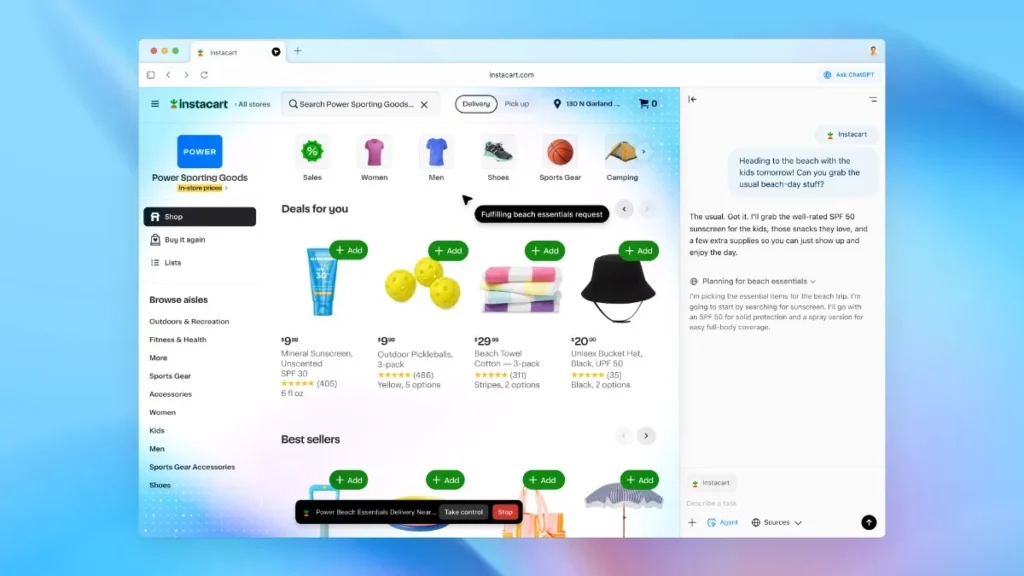
OpenAI’s ChatGPT Atlas, launched in October 2025, is a macOS-only Chromium browser that integrates ChatGPT as the core interface. Its Agent Mode can summarize, analyze, and complete multi-step tasks using browsing context, performing nearly on par with Comet — though it may struggle with complex workflows like e-commerce.
However, privacy is its main drawback, as browsing data is processed on OpenAI’s cloud with limited isolation options outside enterprise plans. A prompt injection flaw at launch was quickly patched, and Windows and mobile versions are expected in 2026.
Verdict: A powerful and intelligent browser held back slightly by its macOS-only availability and cloud-heavy privacy posture. Expect it to climb this ranking as the Windows version rolls out.
3. Microsoft Edge with Copilot
Best for Enterprise & Microsoft 365 Users
🏆 Best For: Business users, IT professionals, and anyone deep in the Microsoft ecosystem — Office, Teams, OneDrive, and Windows 11.
Speed: ⚡⚡⚡⚡ | Intelligence: 🧠🧠🧠🧠 | Privacy: 🔒🔒🔒 | Pricing: Free / Microsoft 365 subscription
Microsoft Edge with Copilot is one of the most mature AI browsers, backed by years of development and deep integration with Microsoft 365 tools like Word, Excel, Outlook, and Teams. Its AI delivers high-quality page summaries and content analysis, while SmartScreen and customizable Tracking Prevention provide strong security. Enterprise users also get data isolation through Copilot for Business.
However, many advanced AI features require a Microsoft 365 subscription, and its agent capabilities are more limited than rivals like Comet or Atlas.
Verdict: The safest, most reliable choice for business environments. Not the most revolutionary AI browser, but the most mature and ecosystem-friendly one.
4. Dia by The Browser Company

Best Design & Most Promising Newcomer
🏆 Best For: macOS users who want an AI-first browsing experience with a clean, intuitive interface and strong design sensibility.
Speed: ⚡⚡⚡ | Intelligence: 🧠🧠🧠🧠 | Privacy: 🔒🔒🔒🔒 | Pricing: Free / $20/mo (Dia Pro)
Dia is one of the most promising AI browsers, designed to make AI the core browsing layer. Built by The Browser Company and acquired by Atlassian in October 2025, it features tab-aware intelligence that can analyze multiple open tabs, compare information, and generate summaries across sources. Its Skills feature lets users create custom AI shortcuts for repeated tasks.
With Atlassian backing, Dia is set to integrate with tools like Jira and Trello. Currently macOS-only, it shows strong innovation but can face stability issues during heavy multi-tab use.
Verdict: Dia has the best AI-native design and the most exciting roadmap. It’s not quite the daily driver it needs to be yet, but it’s closing in fast. Watch this space.
5. Brave with Leo AI

Best for Privacy Absolutists
🏆 Best For: Privacy-focused users who want AI assistance without sacrificing anonymity or handing data to third-party servers.
Speed: ⚡⚡⚡⚡⚡ | Intelligence: 🧠🧠🧠 | Privacy: 🔒🔒🔒🔒🔒 | Pricing: Free
Brave with Leo is the top choice for privacy-focused users. With over 100 million monthly users, Brave’s built-in AI assistant requires no login, stores no conversations, and anonymizes queries before processing. In 2026, Leo upgraded to the Qwen 14B model, improving response quality while maintaining its privacy-first design.
The trade-off is limited functionality — Leo avoids complex agent tasks like bookings or inbox management. However, users get a fast, memory-efficient browser, a native ad blocker, and AI assistance that prioritizes data protection.
Verdict: The uncontested privacy champion. If you want AI help without surveillance, Brave Leo is unmatched. Just don’t expect it to act autonomously on your behalf.
6. Google Chrome with Gemini
Best Ecosystem Integration, Still Catching Up on AI
🏆 Best For: Users already invested in the Google ecosystem — Gmail, Google Docs, Calendar, Drive — who want seamless AI integration.
Speed: ⚡⚡⚡⚡⚡ | Intelligence: 🧠🧠🧠 | Privacy: 🔒🔒 | Pricing: Free / $20/mo (Gemini Advanced)
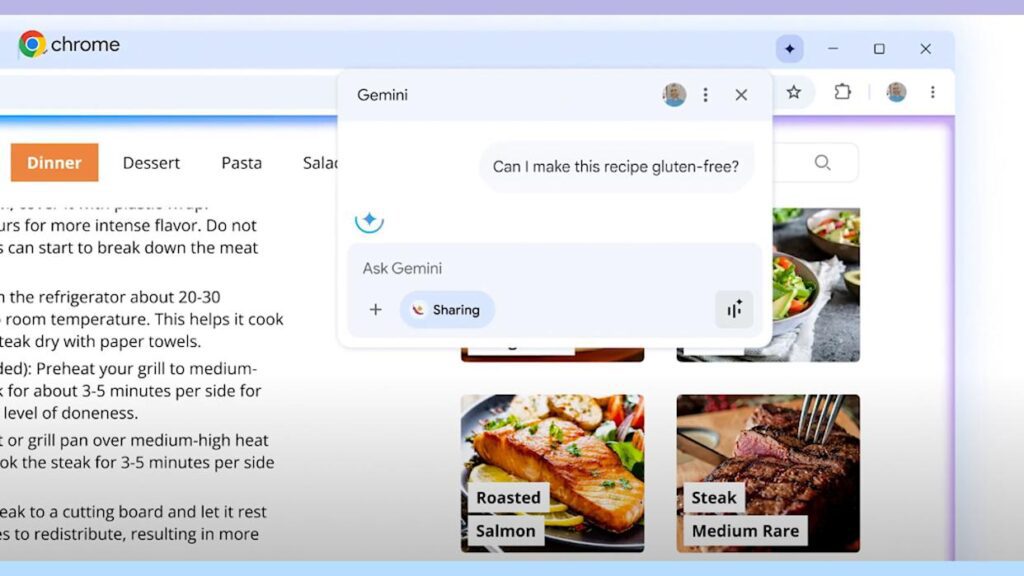
In 2026, Chrome remains a dominant player with a 66% market share, focused on staying competitive in AI. Its Gemini 3 integration works seamlessly with Google services like Gmail, Docs, and Maps, while the new Auto Browse feature enables limited multi-step automation for Premium users. Chrome also includes Gemini Nano for fast on-device translation and writing assistance.
Privacy remains its biggest drawback due to strong ties to Google’s ad ecosystem. For users invested in Google’s services, Chrome still offers unmatched integration despite growing AI competition.
Verdict: Still the world’s most popular browser for good reason — speed, compatibility, and ecosystem depth. Its AI features are improving but not yet category-leading. The one to beat, even as it trails in the AI-native race.
7. Opera One with Aria AI
Best Free AI Browser for Mainstream Users
🏆 Best For: Casual users who want a capable, beginner-friendly AI browser that’s completely free with no sign-up required.
Speed: ⚡⚡⚡⚡ | Intelligence: 🧠🧠🧠 | Privacy: 🔒🔒🔒 | Pricing: Free (Neon tier at $19.90/mo for power users)
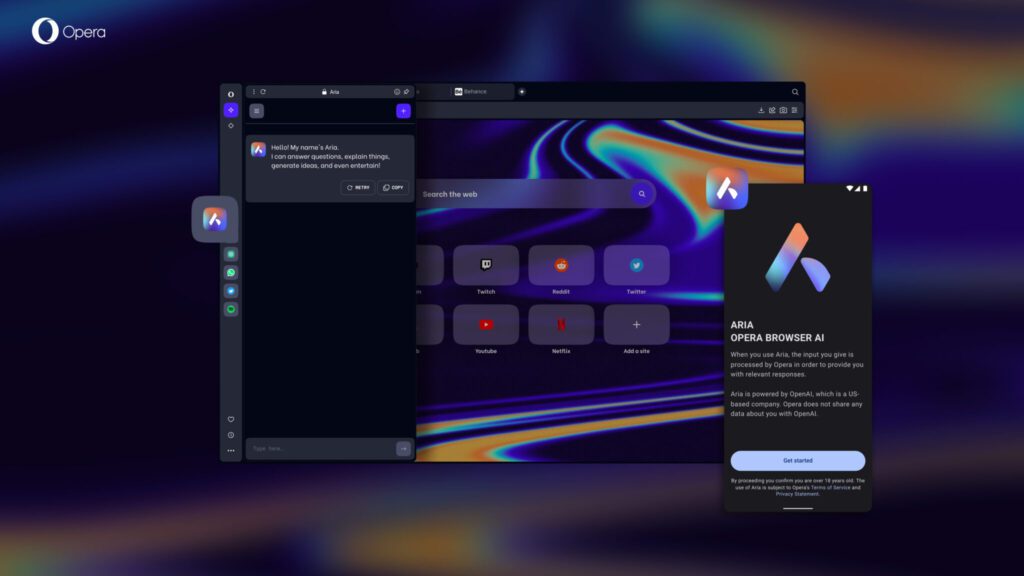
Opera has been integrating AI longer than most rivals. Its built-in assistant, Aria, offers chat, page summaries, writing help, content generation, and image creation directly in the sidebar — no sign-up required. With over 290 million users, Opera One is an accessible, stable AI browser for mainstream users, while the Neon tier adds advanced automation features.
Available across major platforms, Opera balances capability and usability, but its privacy protections are less robust than Brave or DuckDuckGo, and concerns about data practices persist.
Verdict: Opera One is the “AI browser for everyone” — free, accessible, cross-platform, and genuinely useful. A solid pick for users who want AI features without switching ecosystems or paying a subscription.
8. Duck.ai by DuckDuckGo
Best Pure-Privacy AI Browser
🏆 Best For: Users for whom privacy is the absolute first priority, willing to trade advanced AI capabilities for ironclad anonymity.
Speed: ⚡⚡⚡⚡ | Intelligence: 🧠🧠 | Privacy: 🔒🔒🔒🔒🔒 | Pricing: Free
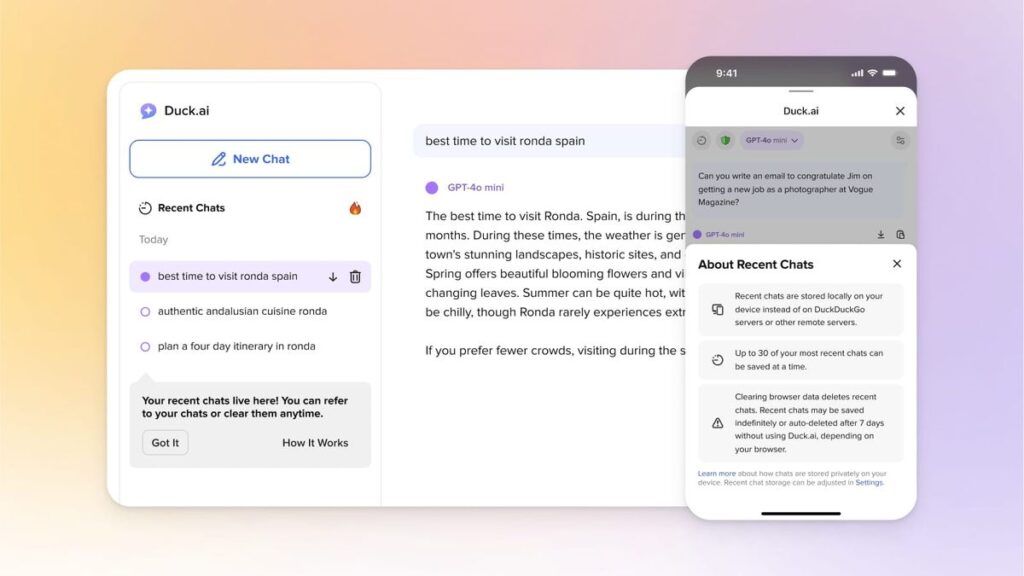
Duck.ai reflects DuckDuckGo’s long-standing privacy-first philosophy, extending anonymous data protection into AI browsing. It lets users chat with multiple models like ChatGPT and Claude through encrypted relays, ensuring conversations remain private and aren’t stored or used for training. A 2026 update added secure voice chat with the same protections.
Duck.ai prioritizes privacy over power. It lacks advanced intelligence and agentic features, avoiding autonomous task execution — a deliberate choice to limit data access and protect user anonymity.
Verdict: If privacy is your religion, Duck.ai is your church. The most private AI browsing experience available, by a significant margin. Just come in knowing that ‘maximum privacy’ and ‘maximum AI capability’ are, for now, mutually exclusive.
How to Choose the Right AI Browser for You
With eight strong contenders in the ring, the right choice comes down to what you value most. Here’s a quick decision guide:
Choose Perplexity Comet if…
- You do heavy research and want AI that cites its sources
- You want agentic browsing (AI that acts for you) without paying enterprise prices
- You’re comfortable with cloud-based AI processing
Choose ChatGPT Atlas if…
- You’re a ChatGPT Plus or Pro subscriber who wants to embed ChatGPT into every website you visit
- You’re on macOS and want the most advanced AI agent available
- You prioritize AI intelligence over privacy
Choose Microsoft Edge with Copilot if…
- You’re a business user in the Microsoft 365 ecosystem
- You need reliability and enterprise-grade security over cutting-edge AI features
- You want the most polished integration with Office, Teams, and Outlook
Choose Dia if…
- You’re on macOS and love well-designed software
- You want AI woven into the browsing experience from the ground up
- You’re excited about the Atlassian-powered enterprise roadmap
Choose Brave Leo if…
- Privacy is your top priority — non-negotiable
- You want fast, reliable browsing with a capable AI assistant that respects your data
- You don’t need agentic (autonomous) AI capabilities
Choose Chrome with Gemini if…
- You’re already embedded in the Google ecosystem (Gmail, Docs, Drive)
- You want the most compatible browser with the widest extension library
- You’re waiting for Chrome’s agentic features to mature
Choose Opera One if…
- You want a free, no-sign-up AI browser that works on any device
- You’re a mainstream user who wants AI smarts without a steep learning curve
Choose Duck.ai if…
- Privacy is your absolute, non-negotiable requirement
- You want to use multiple AI models (ChatGPT, Claude) anonymously
- You’re not looking for autonomous/agentic AI features
A Note on Security in the Age of Agentic Browsers
Agentic AI browsers in 2026 bring real and evolving security risks. When a browser acts on your behalf — reading emails, clicking links, or filling forms — it can inherit your access, making it vulnerable to prompt injection attacks that may expose sensitive data.
Such vulnerabilities have been found in browsers like Comet and Atlas, though patches and safeguards — including user approval prompts — are emerging as best practice. The key takeaway: agentic browsers are powerful but require caution, careful site access, and regular updates to stay secure.
The Bottom Line
There’s no single “best” AI browser in 2026 — only different priorities. Perplexity Comet and ChatGPT Atlas push autonomous capabilities, while Brave Leo and Duck.ai show privacy and intelligence can coexist.
What’s clear is that passive browsers are gone. Whether you prefer Comet’s power, Edge’s ecosystem integration, Brave’s privacy, or Dia’s design, modern browsers now actively assist you.
Our top pick for most users is Perplexity Comet for its balance of power, accessibility, and rapid improvement — but ultimately, users now have real choice in how intelligent their browser should be.